
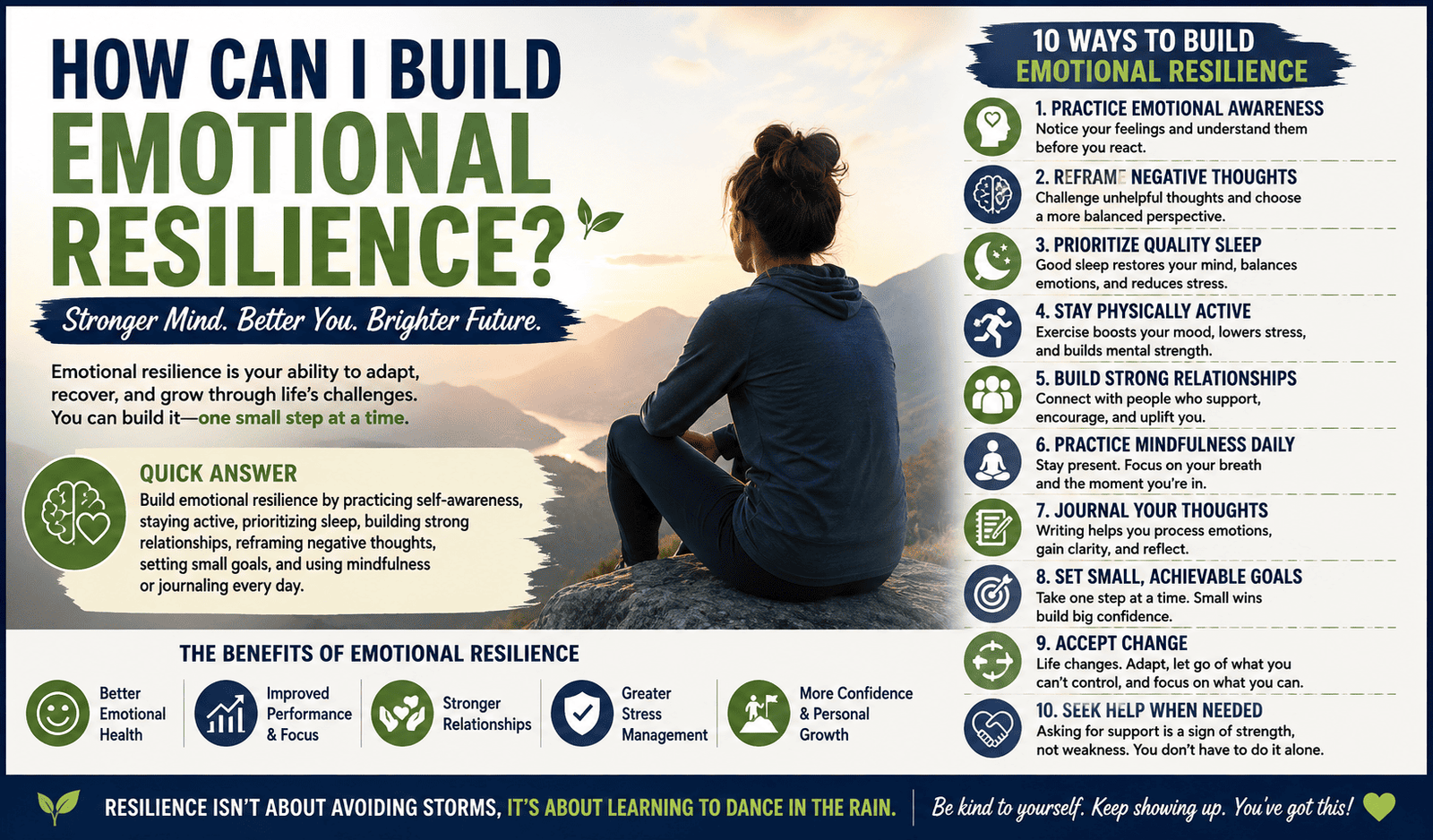
Emotional resilience is the ability to adapt, recover, and grow through stress, setbacks, and life challenges. You can strengthen it by practicing emotional awareness, improving sleep and physical activity, building supportive relationships, reframing negative thoughts, setting realistic goals, and using mindfulness or journaling consistently. Emotional resilience is a skill that anyone can develop with daily practice.
How Can I Build Emotional Resilience?
Life in the United States often moves at a relentless pace. Between demanding careers, financial responsibilities, family obligations, and constant digital stimulation, emotional stress has become a daily reality for millions of Americans. While you cannot eliminate every challenge, you can develop the ability to respond to adversity with greater confidence, flexibility, and inner strength. That ability is called emotional resilience.
Emotional resilience does not mean pretending everything is fine or avoiding difficult emotions. Instead, it means recognizing painful experiences, managing your emotional responses in healthy ways, and gradually bouncing back after setbacks. Whether you’re coping with workplace stress, relationship difficulties, grief, or unexpected life changes, resilience helps protect both your mental and physical well-being.
Also Read : Can Loneliness Affect Mental Health?
What Is Emotional Resilience?
Emotional resilience is your psychological capacity to adapt successfully during periods of stress, trauma, or uncertainty. Rather than avoiding emotional pain, resilient people acknowledge it while continuing to move forward with purpose and hope.
Psychologists describe resilience as an ongoing process instead of a permanent personality trait. This means you are not simply born resilient or non-resilient. Your daily habits, relationships, mindset, and coping strategies all influence how resilient you become throughout life. The encouraging news is that resilience can be strengthened at any age through consistent healthy behaviors.
Also Read : Why Do I Feel Unmotivated Every Morning?
Why Emotional Resilience Matters?
Your emotional and physical health are deeply connected. Chronic stress keeps the body’s fight-or-flight response activated, increasing blood pressure, disrupting sleep, weakening immunity, and contributing to anxiety and depression. Building resilience helps regulate this stress response and improves your ability to recover emotionally after difficult experiences.
People with higher emotional resilience often experience better emotional regulation, stronger relationships, improved workplace performance, healthier lifestyle choices, and greater overall life satisfaction. Rather than eliminating stress, resilience changes how effectively you respond to it.
Also Read : How Does Exercise Improve Mental Well-Being?
Signs You May Need to Build Emotional Resilience
Many people don’t realize they struggle with resilience until everyday challenges begin feeling overwhelming. If you find yourself becoming emotionally exhausted after small setbacks, replaying negative events for days, avoiding difficult conversations, or feeling unable to adapt to change, your resilience may need strengthening.
Other signs include persistent negative self-talk, withdrawing from supportive relationships, difficulty recovering after criticism, emotional eating, poor sleep during stressful periods, and feeling powerless when facing uncertainty. Recognizing these patterns is the first step toward creating healthier emotional habits.
Also Read : What Are the Early Signs of Chronic Stress?
1. Practice Emotional Awareness
The foundation of resilience begins with understanding your emotions before reacting to them. Many people suppress uncomfortable feelings, believing that ignoring them makes them disappear. In reality, suppressed emotions often increase stress and emotional tension over time.
When something upsetting happens, pause for a moment and identify exactly what you’re feeling. Instead of simply saying “I’m stressed,” ask whether you’re actually feeling disappointed, anxious, frustrated, embarrassed, or overwhelmed. Naming emotions helps create psychological distance from them, allowing you to respond thoughtfully instead of reacting impulsively.
Emotional awareness also improves communication because it helps you express your feelings more clearly in personal and professional relationships.
Also Read : Can Social Media Harm Mental Health?
2. Reframe Negative Thinking
Your thoughts influence how you experience adversity. Emotional resilience grows when you learn to challenge automatic negative beliefs instead of accepting them as facts.
For example, replacing “I always fail” with “This setback teaches me something valuable” shifts your focus from hopelessness to growth. Instead of viewing mistakes as proof of inadequacy, resilient people see them as temporary experiences that provide learning opportunities.
This practice, often called cognitive reframing, gradually changes your internal dialogue and makes stressful situations feel more manageable.
Also Read : Why Do I Feel Emotionally Numb?
3. Prioritize Quality Sleep
Sleep is one of the most powerful tools for emotional recovery. During deep sleep, the brain processes emotional experiences, regulates mood, and restores cognitive performance. Poor sleep makes everyday challenges feel significantly larger than they actually are.
Adults generally benefit from seven to nine hours of quality sleep each night. Maintaining a consistent bedtime, limiting screen exposure before sleeping, and creating a relaxing nighttime routine can improve emotional stability and reduce stress sensitivity.
Better sleep doesn’t eliminate problems, but it gives your brain the resources needed to solve them more effectively.
Also Read : How Can I Improve My Mental Health Every Day?
4. Move Your Body Regularly
Exercise strengthens both physical and emotional health. Regular movement reduces stress hormones, increases endorphins, improves sleep quality, and enhances emotional regulation.
You don’t need an intense fitness routine to become more resilient. Walking, swimming, cycling, yoga, dancing, or strength training several days each week can produce meaningful mental health benefits. The key is consistency rather than perfection.
Physical activity also creates a sense of accomplishment, which helps rebuild confidence during emotionally difficult periods.
Also Read : Why does stress affect my stomach?
5. Strengthen Supportive Relationships
One of the strongest predictors of emotional resilience is having meaningful social connections. Humans naturally recover from adversity more effectively when they feel supported by trusted friends, family members, coworkers, or community groups.
Support doesn’t require a large social circle. Even one dependable relationship can provide emotional validation, practical advice, and hope during stressful times. Rather than isolating yourself during hardship, consider reaching out to someone you trust, joining a local community group, or reconnecting with an old friend.
Healthy relationships remind us that we don’t have to navigate life’s challenges alone.
Also Read : Can burnout make you physically sick?
6. Practice Mindfulness Daily
Mindfulness teaches you to observe thoughts and emotions without becoming controlled by them. Instead of trying to eliminate stress, mindfulness changes your relationship with stressful experiences.
A simple breathing exercise can calm the nervous system within minutes. Slowly inhale through your nose, pause briefly, and exhale longer than you inhale. Repeating this pattern helps reduce physical tension and improves emotional regulation over time.
Even five to ten minutes of daily mindfulness can increase focus, reduce anxiety, and improve resilience during challenging situations.
Also Read : What are symptoms of high cortisol?
7. Use Journaling to Process Emotions
Writing is an effective way to organize overwhelming thoughts and better understand your emotional patterns. Journaling allows you to express feelings honestly without fear of judgment while helping your brain process difficult experiences.
Rather than documenting every event of your day, reflect on meaningful questions. What challenged you today? How did you respond emotionally? What lesson can you carry into tomorrow?
Over time, journaling helps identify recurring triggers and reveals personal growth that might otherwise go unnoticed.
Also Read : Can overthinking affect physical health?
8. Set Small, Achievable Goals
Large problems often feel impossible during stressful periods. Emotional resilience grows when you break overwhelming challenges into smaller, manageable actions.
If you’re facing financial pressure, career uncertainty, or relationship difficulties, focus on completing one meaningful task today rather than solving everything at once. Small victories restore confidence and create momentum for continued progress.
Progress is built through consistent action, not dramatic transformation.
Also Read : Why do I feel anxious at night?
9. Accept Change Instead of Fighting It
Life constantly changes. Careers evolve, families grow, relationships shift, and unexpected events occur regardless of our plans. Emotional resilience involves accepting reality while choosing constructive action.
Acceptance is not surrender. It simply means recognizing what cannot be controlled so your energy can be directed toward what can. This mindset reduces unnecessary emotional exhaustion and increases psychological flexibility during uncertain times.
Learning to adapt often becomes more valuable than trying to maintain perfect control.
Also Read : What foods help reduce stress?
10. Seek Professional Support When Needed
Building emotional resilience doesn’t mean handling every challenge alone. Sometimes the strongest decision is asking for help.
If persistent anxiety, depression, trauma, grief, or overwhelming stress begins interfering with daily life, speaking with a licensed mental health professional can provide valuable coping strategies. Therapy offers evidence-based techniques that strengthen emotional regulation, improve thought patterns, and support long-term resilience.
Seeking support reflects self-awareness and courage rather than weakness.
Also Read : Can lack of sleep worsen anxiety?
A Simple 7-Day Emotional Resilience Routine
Creating resilience begins with small daily habits rather than occasional motivation. On Monday, spend ten minutes practicing mindful breathing. Tuesday can include a thirty-minute walk outdoors to reduce stress and improve mood. Wednesday is a good day to write three things you’re grateful for in a journal. Thursday, reach out to a trusted friend or family member for a meaningful conversation. Friday, challenge one negative thought by replacing it with a balanced perspective. Saturday, complete one personal goal you’ve been postponing, no matter how small. Sunday, reflect on the week and write down one lesson you learned about yourself.
Repeating this weekly routine consistently helps strengthen emotional flexibility and create healthier responses to stress.
Also Read : How to calm anxiety naturally at home?
Emotional Resilience vs Mental Toughness
Although these concepts are often confused, they are different. Mental toughness focuses on perseverance, discipline, and performing under pressure. Emotional resilience emphasizes adapting, recovering, and maintaining psychological well-being after adversity.
A mentally tough person may push through discomfort, while an emotionally resilient person recognizes difficult emotions, processes them in healthy ways, and continues moving forward. True wellness often requires both determination and emotional flexibility.
Also Read : What are the signs of emotional burnout?
Common Myths About Emotional Resilience
Many people believe resilient individuals never cry or feel overwhelmed. In reality, emotionally resilient people experience sadness, fear, frustration, and disappointment just like everyone else. The difference is that they recover more effectively instead of becoming stuck in those emotions.
Another common myth is that resilience means complete independence. Strong social support is actually one of the most important protective factors for emotional health. Resilience is also not something developed only after major trauma. Everyday habits like exercise, quality sleep, gratitude, mindfulness, and healthy relationships gradually strengthen resilience long before life’s biggest challenges appear.
Also Read : Why do I feel overwhelmed for no reason?
When Should You Seek Help?
Feeling stressed occasionally is a normal part of life, but persistent emotional distress deserves attention. If sadness lasts for several weeks, anxiety becomes overwhelming, sleep remains consistently disrupted, daily responsibilities become difficult, or emotional pain begins affecting work and relationships, it is important to seek support from a qualified healthcare or mental health professional.
Early intervention often leads to better long-term emotional well-being and healthier coping skills.
Also Read : Can stress cause physical symptoms?
Conclusion
So, how can you build emotional resilience? The answer lies in practicing small, intentional habits every day. By developing emotional awareness, improving sleep, exercising regularly, nurturing supportive relationships, practicing mindfulness, journaling, reframing negative thoughts, accepting change, and seeking help when needed, you gradually strengthen your ability to recover from life’s challenges.
Emotional resilience is not about becoming fearless or emotionally perfect. It is about learning to face adversity with greater confidence, compassion, and adaptability. Every healthy choice you make today becomes another layer of strength for tomorrow.
Also Read : How to reduce cortisol naturally?
Frequently Asked Questions (FAQs)
1. What is emotional resilience?
Emotional resilience is the ability to adapt, recover, and grow after experiencing stress, setbacks, or difficult life events.
2. Can anyone build emotional resilience?
Yes. Emotional resilience is a learnable skill that develops through healthy habits, supportive relationships, emotional awareness, and consistent practice.
3. How long does it take to become more resilient?
There is no fixed timeline. Many people notice positive changes within a few weeks of practicing healthy coping strategies consistently, while long-term resilience develops over months.
4. Does exercise really improve emotional resilience?
Yes. Regular physical activity helps reduce stress, improve mood, enhance sleep quality, and strengthen emotional regulation.
5. Is emotional resilience the same as mental strength?
No. Mental strength emphasizes perseverance under pressure, while emotional resilience focuses on adapting, recovering, and maintaining emotional well-being after challenges.
6. Can mindfulness reduce stress?
Yes. Daily mindfulness helps calm the nervous system, improve focus, and reduce emotional reactivity during stressful situations.
7. Why is sleep important for emotional health?
Quality sleep supports emotional processing, mood regulation, memory, decision-making, and overall psychological recovery from daily stress.
8. Does journaling help with emotional resilience?
Yes. Journaling helps organize thoughts, identify emotional patterns, process difficult experiences, and develop greater self-awareness.
9. What is the fastest way to start building resilience?
Begin with small daily habits such as mindful breathing, regular exercise, quality sleep, gratitude journaling, and meaningful conversations with supportive people.
10. When should I consider professional therapy?
If stress, anxiety, depression, grief, or emotional exhaustion consistently interfere with your daily life, relationships, work, or overall well-being, seeking professional support is a healthy and effective step.

Self-care practices play an important role in emotional resilience.
Medical Disclaimer: This article is intended for general educational and informational purposes and does not provide medical advice, diagnosis, or treatment. Stress-related symptoms can overlap with many other medical and mental health conditions. If you have persistent, severe, or concerning symptoms, consult a qualified healthcare professional for personalized evaluation and guidance.
Reviewed by: Dzarro Editorial Team
Fact-checked using trusted medical and scientific sources.

Sandip Choudhary is a Health & Wellness Researcher and Content Creator specializing in sleep, digestive health, preventive wellness, and evidence-based health education. He has been creating online content and researching health-related topics for several years, focusing on translating complex medical information into practical guidance for everyday readers.
With a strong background in SEO and content strategy, Sandip ensures that every article is optimized for both search engines and real users. His goal is to provide reliable, clear, and helpful information that supports healthier living.
Disclaimer: The content published is for informational purposes only and is not a substitute for professional medical advice.
2 thoughts on “How Can I Build Emotional Resilience?”
Comments are closed.