
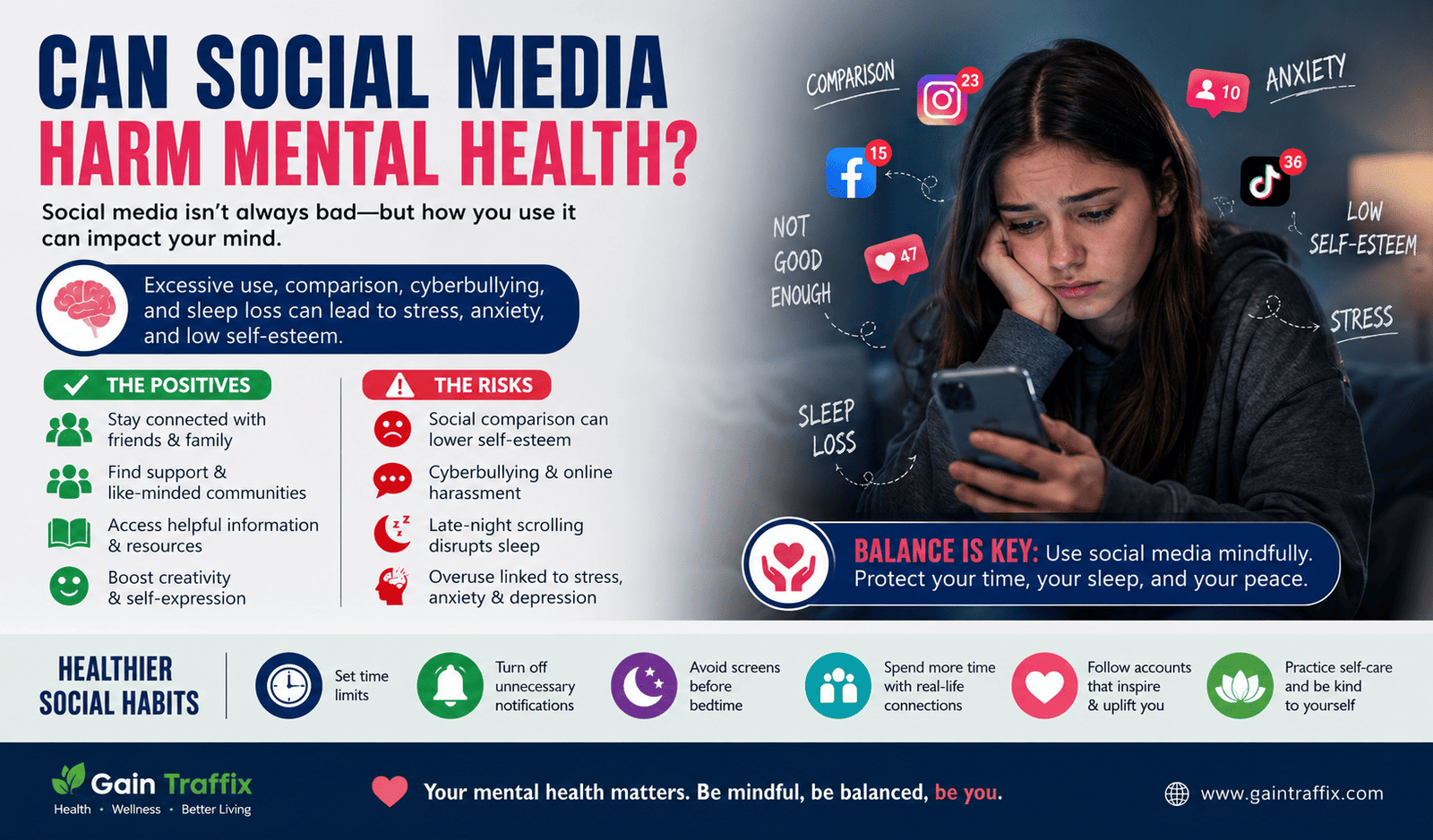
Yes, social media can harm mental health in some people, particularly when use becomes excessive, disrupts sleep, encourages unhealthy social comparison, exposes users to cyberbullying or harmful content, or begins replacing meaningful offline relationships. However, social media is not inherently harmful. Research from the American Psychological Association (APA) indicates that its effects depend on factors such as how a person uses social media, what content they encounter, their age, personal vulnerabilities, and their social environment. Social media can also provide connection, emotional support, community, and access to helpful information.
Introduction
Social media has become a normal part of everyday life in the United States. People use platforms such as Instagram, Facebook, TikTok, YouTube, Reddit, Snapchat, and X to communicate with friends, follow news, discover products, share experiences, build communities, and express themselves. For many people, social media is convenient and enjoyable. At the same time, growing concern about its relationship with mental health has led many Americans to ask an important question: Can social media harm mental health?
The answer is more complicated than simply saying social media is good or bad. Social media can influence mental well-being in both positive and negative ways. The American Psychological Association emphasizes that social media is not inherently beneficial or harmful, particularly for adolescents. The impact depends on the individual, the content they encounter, the features they use, and how social media fits into their daily life.
For some people, social media can provide valuable social connection and emotional support. For others, constant notifications, comparison, negative comments, cyberbullying, appearance-focused content, or late-night scrolling can contribute to stress and emotional difficulties. Understanding these differences can help people develop healthier digital habits without assuming that they need to completely abandon social media.
Also Read : Why Do I Feel Emotionally Numb?
How Can Social Media Harm Mental Health?
One major concern is social comparison. Social media often exposes users to carefully selected images and updates showing vacations, relationships, careers, physical appearances, financial success, and other seemingly positive experiences. When people compare their everyday lives with the highly edited version of someone else’s life online, they may feel inadequate or dissatisfied.
Appearance-related comparison can be particularly concerning. According to the APA, research has associated social media use involving appearance-based social comparison with poorer body image, disordered eating, and depressive symptoms, particularly among adolescent girls.
Another potential problem is cyberbullying and online harassment. Unlike many face-to-face interactions, harmful social media content can be shared quickly and potentially reach a large audience. Repeated exposure to online discrimination, hate, harassment, or bullying can negatively affect psychological well-being. APA research indicates that online discrimination and hate are associated with increases in anxiety and depressive symptoms among adolescents.
Social media can also expose vulnerable users to content involving self-harm, eating disorders, dangerous behaviors, or other psychologically harmful material. The APA recommends minimizing young people’s exposure to content that encourages or instructs health-risk behaviors and stresses the importance of reporting and removing harmful material.
Sleep is another important factor. Scrolling through social media late at night can keep people mentally stimulated when they should be preparing for sleep. Notifications may also encourage people to check their phones repeatedly. The APA notes that technology use, particularly close to bedtime, and social media use specifically, are associated with sleep disruption in adolescents.
Poor sleep matters because sleep plays an important role in emotional regulation, concentration, energy, and overall health. Therefore, social media may affect mental well-being indirectly when nighttime use contributes to insufficient or disrupted sleep.
Also Read : How Can I Improve My Mental Health Every Day?
Can Social Media Cause Anxiety?
Social media may contribute to anxiety in some people, although it is important not to assume that social media alone causes an anxiety disorder. Mental health conditions are complex and can involve biological, psychological, social, and environmental factors.
A person may feel anxious because they are worried about how others perceive them, waiting for responses to messages, monitoring likes and comments, or repeatedly checking whether someone has interacted with their content. Others may experience stress from constantly following negative news, arguments, political disagreements, or upsetting events.
The design of some social media platforms may also encourage repeated checking. Features such as notifications, recommendations, likes, endless scrolling, and continuously updated feeds can make it easy to spend more time online than originally intended. The APA specifically identifies problematic social media use as a concern when use interferes with everyday responsibilities, relationships, education, or other important activities.
Also Read : Why does stress affect my stomach?
Can Social Media Contribute to Depression?
Social media does not automatically cause depression, but certain patterns of use may be associated with poorer emotional well-being. For example, someone who already feels lonely or depressed may use social media excessively as a way to escape difficult emotions. If that use leads to isolation, sleep disruption, comparison, cyberbullying, or exposure to negative content, it may create an unhealthy cycle.
At the same time, social media can sometimes help people who are experiencing loneliness or social isolation. Online communities can provide opportunities to communicate with others who share similar experiences and interests. The APA notes that social media may support social connection, companionship, emotional intimacy, and access to peer support, particularly for people who experience isolation.
This is why the relationship between social media and depression should not be viewed as one-directional. A person’s existing mental health can influence how they use social media, while their online experiences may also influence their emotional well-being.
Also Read : Can burnout make you physically sick?
Why Social Media Can Be Especially Important for Teenagers
Teenagers may be particularly sensitive to certain social media experiences because adolescence is a period of major social, emotional, and neurological development. Peer feedback, acceptance, appearance, popularity, and belonging can become especially important during this stage.
The APA explains that brain systems involved in attention, feedback, and reinforcement from peers become increasingly sensitive during early adolescence, while systems associated with mature self-control continue developing into adulthood.
This does not mean that every teenager will experience mental health problems because of social media. Instead, it means that parents, caregivers, educators, and teenagers should pay attention to how social media is being used and what effect it appears to have on daily life.
For younger adolescents, the APA recommends developmentally appropriate adult monitoring, discussion, coaching, and boundaries while balancing those measures with a young person’s appropriate need for privacy.
Also Read : What are symptoms of high cortisol?
Is Social Media Ever Good for Mental Health?
Yes. Focusing exclusively on the risks would give an incomplete picture.
Social media can help people maintain relationships when they live far apart. It can allow individuals with uncommon interests or experiences to find communities that may not exist in their immediate surroundings. Someone experiencing loneliness may find encouragement through a supportive online group. People can also discover educational resources, mental health information, creative communities, professional networks, and peer support.
The APA states that certain forms of online social interaction may support psychological development, especially during periods of social isolation or stress.
The important distinction is between purposeful, supportive use and patterns that interfere with health and daily functioning. A person who uses social media to communicate with friends for a reasonable amount of time may have a very different experience from someone who compulsively checks feeds for hours, loses sleep, constantly compares themselves with others, or encounters harmful content.
Also Read : Can overthinking affect physical health?
Signs Social Media May Be Affecting Your Mental Health
One useful way to evaluate your social media habits is to focus on how you feel before, during, and after using it. If you frequently feel anxious, inadequate, angry, lonely, overwhelmed, or emotionally drained after scrolling, your current online habits may deserve attention.
Another warning sign is losing control over your use. You may intend to check an app for five minutes but continue scrolling for an hour. You may repeatedly reach for your phone even when you have important work to complete, conversations to have, or sleep to catch up on.
Changes in sleep, reduced physical activity, withdrawal from offline relationships, difficulty concentrating, and increased dependence on online validation can also indicate that social media is taking too much space in your life. The APA identifies repeated use beyond intended limits and disruption of important relationships, education, or daily responsibilities as indicators of problematic social media use.
Also Read : Why do I feel anxious at night?
How to Use Social Media in a Healthier Way?
Healthy social media use does not necessarily require deleting every app. Instead, consider creating boundaries that protect your mental and physical health.
Start by paying attention to which accounts make you feel encouraged and which consistently make you feel stressed or inadequate. Unfollowing, muting, or limiting exposure to content that triggers unhealthy comparison can make your feed more supportive.
It can also help to establish technology-free periods during the day, particularly around bedtime. Keeping your phone away from the bed may reduce the temptation to repeatedly check notifications or scroll when you should be sleeping.
Try to make social media a supplement to real-world relationships rather than a replacement for them. Spending time with family, talking with friends in person, exercising, pursuing hobbies, and participating in community activities can provide forms of connection that a digital feed cannot completely replace.
Digital literacy is also important. Social media content is not always an accurate representation of reality. Photos can be edited, opinions can be exaggerated, advertisements can look like ordinary posts, and algorithms can repeatedly show content that captures your attention. Learning to question what you see online can help reduce unhealthy comparisons and misinformation.
For parents of teenagers, conversations are generally more useful than simply issuing rules. Discussing online experiences, privacy, cyberbullying, appearance pressure, harmful content, and healthy boundaries can help young people develop the skills needed to navigate social media responsibly. The APA supports a combination of boundaries, monitoring, and ongoing discussion for adolescents.
Also Read : What foods help reduce stress?
When Should You Consider Taking a Break From Social Media?
A temporary social media break may be worth considering if you notice that social media consistently worsens your mood, interferes with sleep, reduces productivity, creates conflict, or makes you feel constantly pressured to compare yourself with other people.
A break can also help you determine whether your online habits are contributing to a particular problem. Instead of treating the break as a punishment, view it as an opportunity to observe changes in your mood, sleep, concentration, relationships, and daily routine.
However, taking a break should not be considered a substitute for professional mental health care when someone is experiencing significant symptoms. Persistent depression, severe anxiety, major sleep problems, or thoughts of self-harm deserve attention from a qualified healthcare or mental health professional.
Also Read : Can lack of sleep worsen anxiety?
The Bottom Line: Can Social Media Harm Mental Health?
So, can social media harm mental health? Yes, it can, especially when use becomes problematic or when people are repeatedly exposed to harmful content, cyberbullying, unhealthy social comparison, or sleep-disrupting habits. The risks may be particularly important for adolescents, whose social and emotional development is still occurring.
But social media is not automatically harmful. It can also provide connection, companionship, information, community, and emotional support. The healthiest approach is not necessarily to label social media as completely good or completely bad. Instead, consider how you use it, what you see, how much time it occupies, and whether it supports or interferes with your overall well-being.
If social media regularly leaves you feeling worse rather than better, that is useful information. Adjusting your feed, setting boundaries, protecting your sleep, spending more time offline, and seeking professional support when necessary can help you build a healthier relationship with technology.
Also Read : How to calm anxiety naturally at home?
Frequently Asked Questions
1. Can social media harm mental health?
Yes. Social media can negatively affect mental health for some people, particularly when use involves excessive scrolling, cyberbullying, harmful content, unhealthy social comparison, or sleep disruption. However, the impact varies considerably between individuals.
2. Can social media cause depression?
Social media should not be described as a single direct cause of depression. Mental health conditions have many contributing factors. However, certain social media experiences and patterns of use may be associated with poorer emotional well-being, while supportive online communities can also benefit people experiencing loneliness or isolation.
3. Can social media cause anxiety?
Social media may contribute to stress or anxiety in some people through social comparison, online conflict, cyberbullying, constant notifications, fear of missing out, or pressure to receive approval. The effect depends on the individual and their pattern of use.
4. Is social media bad for teenagers?
Social media is not automatically bad for teenagers. It can provide friendship, support, community, and opportunities for positive interaction. However, adolescents may be more vulnerable to certain risks, including cyberbullying, appearance-based comparison, harmful content, problematic use, and sleep disruption.
5. Does social media affect sleep?
Yes. Social media use close to bedtime can be associated with sleep disruption, particularly among adolescents. Late-night scrolling and notifications can also make it harder to maintain a consistent sleep routine.
6. Can social media make you feel lonely?
It can. Passive scrolling or comparing yourself with other people’s online lives may leave some people feeling disconnected or inadequate. However, social media can also reduce loneliness by helping people maintain relationships and find supportive communities.
7. How does social comparison affect mental health?
Comparing your appearance, relationships, career, finances, lifestyle, or achievements with carefully curated online content can create unrealistic expectations. Appearance-focused comparison has been associated with poorer body image and depressive symptoms, particularly among some adolescents.
8. Should I delete social media if it is affecting my mental health?
Deleting social media is not the only option. You could first try reducing your usage, muting or unfollowing stressful accounts, turning off unnecessary notifications, establishing screen-free periods, and avoiding social media before bed. If these changes do not help and social media continues to interfere with your well-being, a longer break may be useful.
9. How can parents help teenagers use social media safely?
Parents can encourage open conversations about online experiences, establish age-appropriate boundaries, monitor use appropriately, discuss cyberbullying and harmful content, and help teenagers develop social media literacy. The APA recommends combining limits and boundaries with ongoing discussion and coaching.
10. When should I seek professional help because of social media use?
Consider speaking with a qualified mental health professional if social media use is accompanied by persistent depression, significant anxiety, severe sleep problems, major disruption to school or work, withdrawal from important relationships, or other symptoms that interfere with everyday life. If you are experiencing thoughts of self-harm or suicide, seek immediate professional or emergency support rather than trying to manage the situation through social media alone.

Healthy habits can improve both physical and mental wellness.
Medical Disclaimer: This article is intended for general educational purposes and is not a substitute for professional medical diagnosis, treatment, or individualized advice. If you have persistent, severe, or concerning symptoms, consult a qualified healthcare professional.
Reviewed by: Dzarro Editorial Team
Fact-checked using trusted medical and scientific sources.

Sandip Choudhary is a Health & Wellness Researcher and Content Creator specializing in sleep, digestive health, preventive wellness, and evidence-based health education. He has been creating online content and researching health-related topics for several years, focusing on translating complex medical information into practical guidance for everyday readers.
With a strong background in SEO and content strategy, Sandip ensures that every article is optimized for both search engines and real users. His goal is to provide reliable, clear, and helpful information that supports healthier living.
Disclaimer: The content published is for informational purposes only and is not a substitute for professional medical advice.