
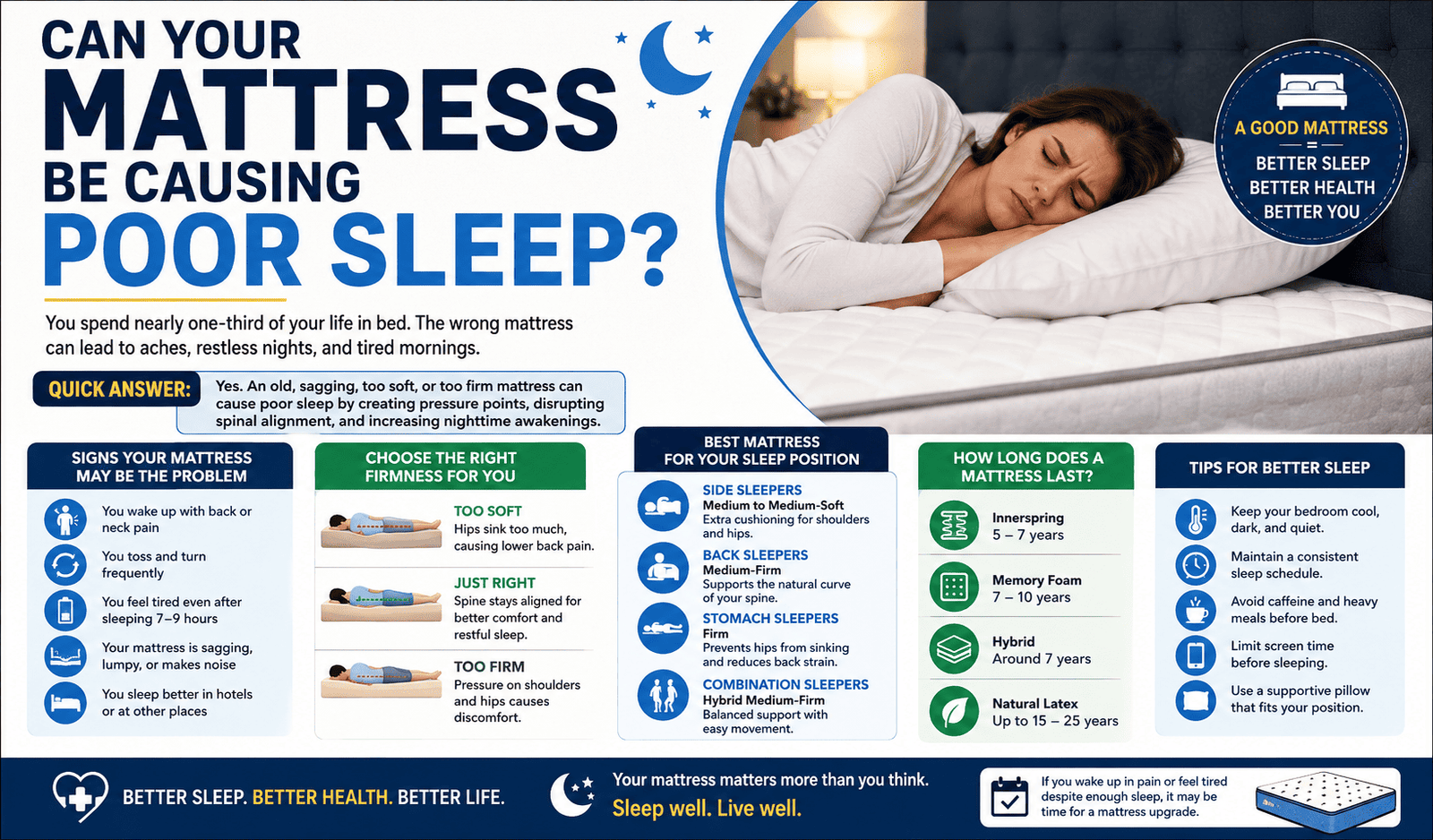
Yes, your mattress can cause poor sleep. A mattress that is too old, too soft, too firm, or no longer provides proper support can disrupt spinal alignment, create pressure points, increase nighttime awakenings, and reduce deep, restorative sleep. If you wake up with back pain, neck stiffness, or feel tired despite sleeping 7–9 hours, your mattress may be a major contributing factor.
Introduction
Do you wake up feeling exhausted even after getting what seems like enough sleep? Many people immediately blame stress, anxiety, caffeine, or excessive screen time. While those factors certainly matter, one of the most overlooked causes of poor sleep is the mattress you sleep on every night.
The average American spends nearly one-third of life in bed. Your mattress is more than a piece of furniture—it directly affects spinal alignment, muscle recovery, circulation, body temperature, and overall sleep quality. When it loses its support or no longer matches your sleeping style, your body spends the night constantly adjusting instead of fully resting.
The good news is that mattress-related sleep problems are often identifiable and, in many cases, fixable. This guide explains how your mattress influences sleep, the warning signs to look for, and what you can do to improve your rest naturally.
Also Read : Does Sleeping Naked Help You Sleep Better?
How Your Mattress Affects Sleep Quality?
Quality sleep depends on much more than simply closing your eyes for eight hours. During sleep, your body cycles through light sleep, deep sleep, and REM sleep. Deep sleep is when muscles repair, hormones regulate, and the immune system strengthens. REM sleep supports memory, learning, and emotional health.
A supportive mattress helps keep your spine in a neutral position throughout these sleep stages. When your shoulders, hips, and lower back are properly supported, your muscles can relax instead of staying partially engaged all night.
An unsupportive mattress has the opposite effect. If your hips sink too deeply or your shoulders experience excessive pressure, your body makes dozens of unconscious movements to find comfort. These frequent adjustments interrupt restorative sleep without you fully realizing it, leaving you feeling tired the next morning.
Also Read : Why Do I Feel More Awake at Night Than During the Day?
Signs Your Mattress Is Causing Poor Sleep
You Wake Up With Back Pain
Morning back pain is one of the strongest indicators that your mattress may not be supporting your spine correctly. If the pain improves after walking around for a few minutes, the problem may be related to your sleeping surface rather than daytime activities.
Your Neck Feels Stiff Every Morning
A mattress and pillow work together to maintain proper alignment. If your mattress sags or creates an uneven sleeping position, your neck muscles remain strained throughout the night, leading to stiffness and headaches.
Also Read : Can Sleeping With a Fan Improve Sleep Quality?
You Toss and Turn Constantly
Changing positions occasionally is normal. However, if you find yourself rolling over every few minutes, your body is likely trying to relieve pressure from uncomfortable areas. Excessive movement reduces sleep efficiency and prevents long periods of uninterrupted deep sleep.
You Wake Up Feeling More Tired Than Before
Sleeping longer doesn’t always mean sleeping better. If your mattress causes frequent micro-awakenings, you may never reach enough restorative sleep even though you remain in bed for eight hours.
Also Read : Why Do My Legs Twitch When I’m Trying to Sleep?
Your Mattress Has Visible Sagging
Look closely at your mattress during the day. Deep body impressions, uneven surfaces, lumps, or squeaking springs are signs that its internal support system has deteriorated. Once structural support is compromised, sleep quality often declines as well.
You Sleep Better Away From Home
Many people notice they sleep surprisingly well in hotels or at a family member’s house. If this happens consistently, your own mattress deserves serious attention because it suggests your sleeping environment—not your body—is contributing to poor sleep.
Also Read : Is It Better to Sleep With Socks On?
Can a Bad Mattress Cause Insomnia?
A mattress is rarely the only cause of insomnia, but it can certainly make it worse.
Insomnia often develops from multiple factors including stress, anxiety, hormonal changes, chronic pain, or medical conditions. However, sleeping on an uncomfortable mattress increases physical discomfort and makes it harder to fall asleep and stay asleep.
People experiencing pain-related insomnia frequently wake several times during the night because pressure builds around the shoulders, hips, or lower back. Improving mattress support may not cure insomnia completely, but it can remove one significant barrier to restorative sleep.
Also Read : Can Seasonal Changes Affect Your Sleep Cycle?
Is Your Mattress Too Soft or Too Firm?
Finding the right firmness is essential because both extremes can negatively affect sleep quality.
A mattress that is too soft allows the pelvis and hips to sink excessively. This creates an unnatural curve in the lower spine, increasing muscle strain and lower back discomfort.
A mattress that is too firm creates excessive pressure against the shoulders and hips. Side sleepers are especially vulnerable because these joints carry much of the body’s weight during the night.
For many adults, a medium-firm mattress provides the ideal balance between comfort and support. It cushions pressure points while keeping the spine aligned in a healthy position.
Also Read : Why Do I Wake Up at the Same Time Every Night?
Best Mattress for Your Sleeping Position
Your preferred sleeping position should influence your mattress choice more than advertising claims.
Side sleepers generally benefit from medium to medium-soft mattresses because they reduce pressure on the shoulders and hips. Back sleepers usually experience better spinal support with a medium-firm surface that maintains the natural curve of the lower back.
Stomach sleepers often need a firmer mattress to prevent the pelvis from sinking too deeply, which can strain the lumbar spine. Combination sleepers who change positions throughout the night usually do well with hybrid mattresses that combine responsive support with pressure relief.
The best mattress is ultimately the one that keeps your spine comfortably aligned regardless of your sleeping position.
Also Read : How much sleep do adults over 40 need?
How Long Should a Mattress Last?
Even high-quality mattresses eventually lose their ability to support the body properly.
Traditional innerspring mattresses typically last between five and seven years. Memory foam and hybrid models often remain comfortable for seven to ten years, while natural latex mattresses can last considerably longer.
Instead of relying only on age, pay attention to performance. If your sleep quality has gradually declined, your mattress feels uneven, or you consistently wake with aches and stiffness, replacement may be worthwhile even if the mattress is still under warranty.
Also Read : Why do I wake up sweating at night?
Can Replacing Your Mattress Improve Sleep?
For many people, yes.
Replacing an old or worn mattress can improve comfort, reduce pressure points, decrease morning pain, and increase overall sleep satisfaction. Many adults report falling asleep faster and waking less frequently after switching to a supportive mattress.
Although a new mattress is not a medical treatment, it can be one of the most effective lifestyle improvements for people whose sleep problems are driven by physical discomfort rather than underlying disease.
Also Read : Can low vitamin D affect sleep?
Other Mattress Problems That Affect Sleep
Overheating
Body temperature naturally drops before sleep. Mattresses that trap heat can interfere with this process, causing sweating, discomfort, and nighttime awakenings.
If you tend to sleep hot, breathable materials such as hybrid construction, cooling foam, or latex may provide better temperature regulation.
Dust Mites and Allergies
Older mattresses collect dust mites, dead skin cells, pollen, and other allergens over time. These allergens may trigger congestion, sneezing, coughing, or asthma symptoms during the night.
Using a washable mattress protector and vacuuming the mattress regularly can help reduce allergen buildup and improve sleep quality.
Also Read : What causes sleep anxiety before workdays?
Motion Transfer
If your partner frequently wakes you by changing positions, the problem may be motion transfer rather than mattress age. Memory foam and many hybrid mattresses absorb movement more effectively, allowing couples to sleep with fewer disturbances.
How to Test Whether Your Mattress Is the Problem?
Before buying a new mattress, try a simple sleep experiment.
Spend several nights sleeping on a different quality mattress if possible. Keep track of how long it takes to fall asleep, how often you wake during the night, and how your body feels in the morning.
If your back pain decreases and your energy improves while sleeping elsewhere, your current mattress becomes a much more likely contributor to poor sleep.
Keeping a two-week sleep journal can also reveal patterns that are easy to miss after a single night.
Also Read : How to reset sleep schedule naturally?
Sleep Tips That Work Alongside a Better Mattress
A supportive mattress works best when combined with healthy sleep habits. Going to bed at the same time every night helps regulate your internal clock. Keeping your bedroom cool, quiet, and dark encourages deeper sleep. Limiting caffeine during the afternoon and reducing screen exposure before bedtime also improves sleep quality.
Don’t forget your pillow. Even an excellent mattress cannot maintain proper neck alignment if your pillow is too high or too flat. Choosing a pillow that matches your sleeping position is equally important.
Small changes in your sleep environment often produce meaningful improvements when practiced consistently.
Also Read : Why does my body feel heavy after waking up?
When Should You See a Healthcare Provider?
If poor sleep continues despite improving your mattress and sleep habits, it’s important to seek medical advice.
Persistent insomnia lasting several months, loud snoring, breathing pauses during sleep, severe daytime sleepiness, or restless leg symptoms may indicate an underlying sleep disorder such as sleep apnea. A healthcare professional can determine whether additional evaluation or treatment is needed.
Never ignore chronic fatigue or persistent sleep problems, especially if they affect your daily life, mood, or ability to concentrate.
Also Read : Can sleep problems affect mental health?
Conclusion
Your mattress may be the hidden reason you’re waking up tired every morning. An old, sagging, overly soft, or excessively firm mattress can reduce sleep quality by disrupting spinal alignment, increasing pressure points, and causing frequent nighttime awakenings.
If you’ve already improved your bedtime routine but still don’t feel rested, evaluating your mattress is a smart next step. Investing in proper sleep support isn’t just about comfort—it’s an investment in your physical health, mental well-being, and overall quality of life.
A better night’s sleep often begins with the surface you sleep on.
Also Read : What are the best nighttime habits for deep sleep?
Frequently Asked Questions (FAQ)
1. Can your mattress really cause poor sleep?
Yes. An unsupportive mattress can reduce sleep quality by causing discomfort, pressure points, and frequent awakenings throughout the night.
2. How do I know if my mattress is causing my back pain?
If your back pain is worst in the morning and improves after getting out of bed, your mattress may be contributing to poor spinal alignment during sleep.
3. What is the best mattress firmness for most adults?
A medium-firm mattress generally offers the best balance of support and pressure relief for a wide range of sleepers.
4. Can a bad mattress make you feel tired all day?
Yes. Interrupted sleep caused by discomfort can reduce deep sleep, leaving you fatigued despite sleeping for several hours.
5. How often should I replace my mattress?
Most mattresses perform well for about 7–10 years, although visible sagging and declining comfort are stronger replacement indicators than age alone.
6. Is memory foam good for sleep quality?
Memory foam provides excellent pressure relief and motion isolation, making it a popular option for many sleepers, especially couples.
7. Can an old mattress worsen allergies?
Yes. Older mattresses can accumulate dust mites and allergens that may trigger nighttime allergy symptoms in sensitive individuals.
8. Why do I sleep better in hotels than at home?
A more supportive mattress, better pillows, and a quieter sleep environment may explain why you rest better away from home.
9. Can a mattress cause neck stiffness?
Absolutely. Poor mattress support can throw your spine and neck out of alignment, leading to stiffness and morning headaches.
10. Should I buy a new mattress if I have insomnia?
A new mattress may help if discomfort is contributing to your insomnia, but persistent sleep problems should also be evaluated by a healthcare provider.

Going to bed at the same bedtime improves sleep.
Medical Disclaimer: This article is for educational purposes only and does not replace professional medical advice, diagnosis, or treatment. Always consult a qualified healthcare provider before making significant changes to your diet, exercise routine, medications, or health management plan.
Medically reviewed information sourced from trusted health organizations.
References
- National Institutes of Health (NIH). Sleep and Sleep Disorders.
https://www.nhlbi.nih.gov/health/sleep - Sleep Foundation. Sleep Health Resources.
https://www.sleepfoundation.org/ - Centers for Disease Control and Prevention (CDC). Sleep and Sleep Disorders.
https://www.cdc.gov/sleep/ - Mayo Clinic. Sleep Disorders Overview.
https://www.mayoclinic.org/
Reviewed by: Dzarro Editorial Team
Fact-checked using trusted medical and scientific sources.

Sandip Choudhary is a Health & Wellness Researcher and Content Creator specializing in sleep, digestive health, preventive wellness, and evidence-based health education. He has been creating online content and researching health-related topics for several years, focusing on translating complex medical information into practical guidance for everyday readers.
With a strong background in SEO and content strategy, Sandip ensures that every article is optimized for both search engines and real users. His goal is to provide reliable, clear, and helpful information that supports healthier living.
Disclaimer: The content published is for informational purposes only and is not a substitute for professional medical advice.