
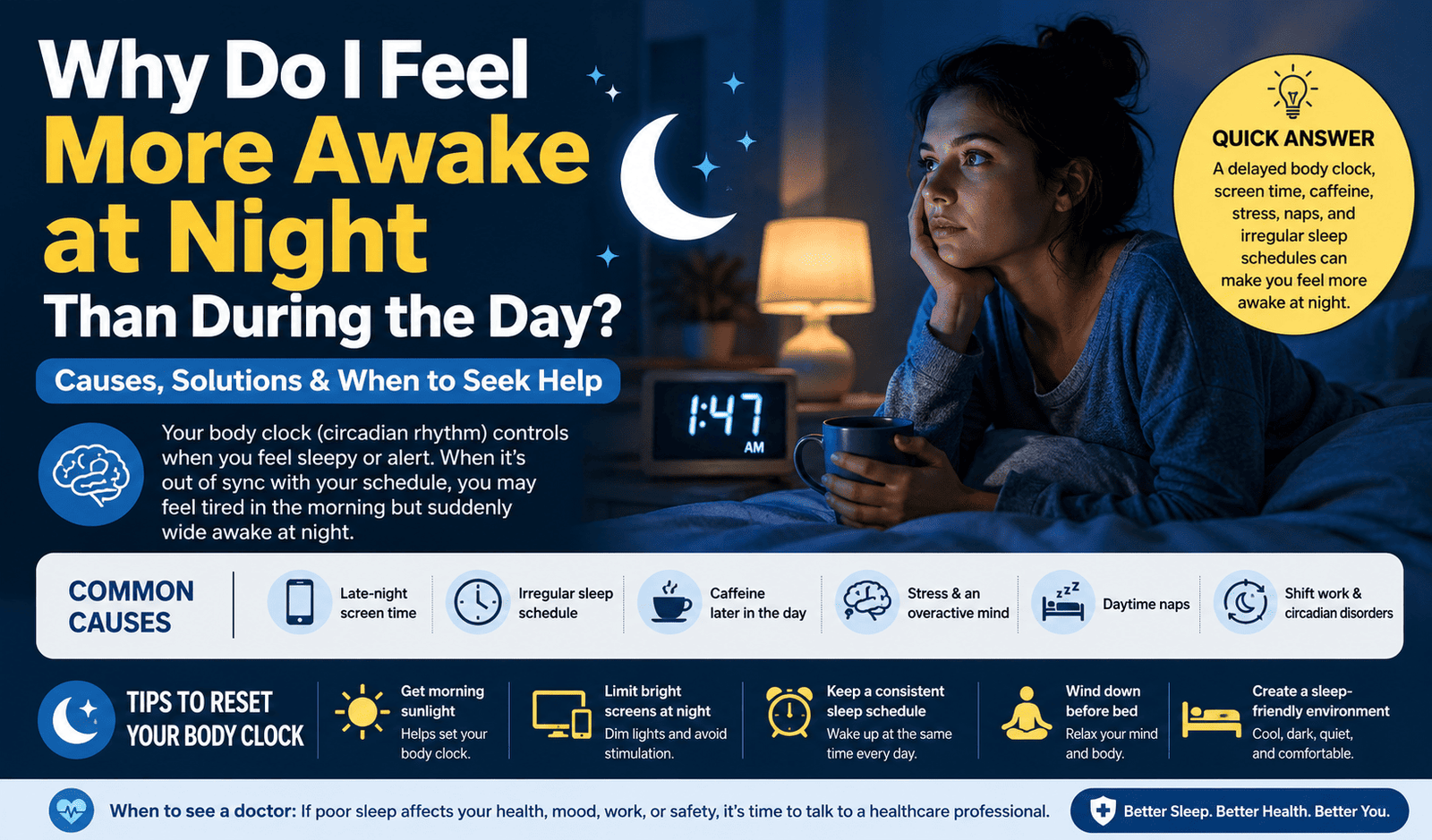
If you feel more awake at night than during the day, your circadian rhythm may be shifted later than your daily schedule. Your natural body clock controls when you feel sleepy and alert, and factors such as late-night screen use, irregular sleep schedules, caffeine, stress, daytime naps, shift work, and insufficient morning light can push your sleep-wake cycle later. In some people, persistent nighttime alertness and difficulty waking in the morning may be related to delayed sleep-wake phase disorder, a circadian rhythm condition in which a person naturally falls asleep and wakes later than desired.
Feeling energetic at night is not necessarily a problem by itself. The bigger concern is whether your sleep timing prevents you from getting enough quality sleep or interferes with work, school, relationships, driving, or daily activities. Most adults need at least 7 hours of sleep in a 24-hour period, yet CDC data show that 30.5% of U.S. adults slept less than 7 hours on average in 2024.
Why Do I Feel More Awake at Night Than During the Day?
Your body has an internal timing system called the circadian rhythm, which operates on an approximately 24-hour cycle. This biological clock helps coordinate sleep, wakefulness, hormone release, body temperature, appetite, and other daily functions. It responds strongly to environmental signals, particularly light and darkness.
Normally, increasing darkness in the evening helps your body prepare for sleep. Melatonin, a hormone associated with sleep timing, rises as your body prepares for nighttime rest. In the morning, exposure to light helps signal that it is time to become more alert. Bright artificial light late in the evening can interfere with this process and make falling asleep more difficult.
When your internal clock becomes shifted toward later hours, you may feel sluggish or sleepy during the morning and early afternoon but suddenly become more alert in the evening. By bedtime, you may feel as though your brain has finally “turned on.” This can create a frustrating cycle in which you stay awake late, sleep late, struggle to wake up, and feel tired during the following day.
Also Read : Why Do My Legs Twitch When I’m Trying to Sleep?
Your Natural Body Clock May Run Late
One reason you may feel more awake at night is simply that your natural sleep preference may be later than the schedule you are trying to follow. Some people naturally tend to wake early, while others naturally stay awake later. Genetics can influence these differences in sleep timing.
Having a late chronotype does not automatically mean you have a sleep disorder. The problem arises when your preferred sleep schedule consistently conflicts with your responsibilities. For example, someone who naturally becomes sleepy around 2 a.m. may have difficulty functioning at a job that requires waking at 6 a.m.
If you regularly cannot fall asleep until very late and have substantial difficulty waking at your desired time, delayed sleep-wake phase disorder may be worth discussing with a healthcare professional. It is one of the recognized circadian rhythm disorders and can interfere with work, school, and social responsibilities.
Also Read : Is It Better to Sleep With Socks On?
Late-Night Screen Time Can Make You Feel More Alert
Your nighttime habits can strongly influence your sleep timing. Smartphones, tablets, computers, televisions, and other bright screens expose you to artificial light during a period when your brain should be preparing for sleep.
Bright artificial light in the late evening can interfere with the body’s normal release of melatonin and make it harder to fall asleep.
There is also a behavioral component. Scrolling through social media, watching videos, playing games, answering messages, or working late can keep your brain engaged even when your body needs rest. If this becomes a nightly routine, your brain can begin associating nighttime with stimulation rather than relaxation.
Reducing bright light and stimulating activities before bed may help your brain transition more naturally toward sleep.
Also Read : Can low vitamin D affect sleep?
An Irregular Sleep Schedule Can Shift Your Rhythm
Going to bed at different times every night can make it harder for your body to establish a predictable sleep-wake pattern. Sleeping until noon on weekends after waking early on weekdays can also create what is sometimes called social jet lag.
Your body responds to regular cues such as light exposure, meals, activity, and sleep timing. When those cues change significantly from day to day, your internal clock may have difficulty staying synchronized with your schedule.
A consistent wake-up time is often more useful than simply trying to force yourself into bed earlier. Getting up around the same time each day gives your body a stable anchor for the rest of your sleep-wake cycle.
Also Read : How to reset sleep schedule naturally?
Caffeine May Be Keeping You Awake at Night
Coffee, energy drinks, tea, soda, pre-workout products, and other caffeinated beverages can contribute to nighttime alertness, especially when consumed later in the day.
You may not always feel “wired” after caffeine. Instead, you might notice that you are simply not sleepy when bedtime arrives. If you routinely consume caffeine in the afternoon or evening, consider discussing your intake and timing with a healthcare professional, particularly if sleep problems are persistent.
NHLBI notes that caffeine can affect daytime sleepiness and may recommend avoiding caffeine within eight hours of a desired bedtime for some people with circadian rhythm problems.
Also Read : Why does my body feel heavy after waking up?
Stress and an Overactive Mind Can Increase Nighttime Alertness
Another common explanation is psychological stimulation. During the day, work, family responsibilities, errands, conversations, and other activities can keep your attention occupied. At night, distractions may disappear.
Once you get into bed, your brain may suddenly have time to process worries, plans, unfinished tasks, financial concerns, relationships, or work problems. This can make you feel mentally awake even though your body is tired.
Over time, worrying about not sleeping can create another layer of stress. You may begin watching the clock, calculating how many hours remain before you need to wake up, and becoming increasingly frustrated. That mental stimulation can make sleep even harder.
A predictable wind-down routine can help create a stronger association between nighttime and relaxation.
Also Read : Why do I feel sleepy after lunch every day?
Daytime Naps May Be Reducing Your Sleepiness at Night
If you sleep for long periods during the afternoon or evening, you may reduce the natural pressure to sleep at night.
Your sleep drive builds the longer you stay awake. NHLBI explains that this sleep pressure increases during wakefulness and interacts with your circadian clock to determine when you feel sleepy.
Long or late naps can therefore make it easier to stay awake at night. If nighttime sleep is already difficult, keeping naps shorter and earlier may help, although the ideal approach varies from person to person.
Also Read : What causes night sweats while sleeping? 15 Common Causes, Treatments & When to See a Doctor (2026)
Shift Work Can Reverse Your Normal Sleep Pattern
People who work overnight or rotating shifts may naturally feel awake during the night because their work schedule requires nighttime alertness.
Shift work can make it difficult to obtain uninterrupted, high-quality sleep during the day because the body’s internal clock is still influenced by the normal light-dark cycle. NHLBI identifies shift work disorder as a circadian rhythm disorder that can involve insomnia, extreme tiredness, and sleepiness while working at night.
If you work nights, your sleep strategy may need to be different from someone working a traditional daytime schedule.
Also Read : Why do I wake up tired even after 8 hours of sleep?
Could It Be Delayed Sleep-Wake Phase Disorder?
If you consistently fall asleep much later than you want, struggle to wake up in the morning, and feel substantially more alert later in the day, delayed sleep-wake phase disorder could be one possible explanation.
With this condition, the person’s sleep is delayed relative to conventional schedules. Someone may be capable of sleeping normally when allowed to follow their preferred schedule but have considerable difficulty sleeping and waking at socially expected times.
This is different from simply staying up late occasionally. Persistent symptoms that interfere with daily responsibilities deserve professional evaluation.
Also Read : Can Sleeping With a Fan Improve Sleep Quality?
Why Am I So Tired During the Day but Awake at Night?
This pattern can happen when your circadian rhythm and your daily schedule are out of sync. You may be biologically inclined toward later sleep, while work or school requires early waking.
It can also happen because you are accumulating sleep debt. If you repeatedly sleep too little at night, you may feel exhausted during the day but experience a temporary increase in alertness later in the evening. Circadian timing and sleep pressure can interact in complicated ways, so feeling more awake at night does not necessarily mean your body has suddenly stopped needing sleep.
In the United States, insufficient sleep remains common. According to the CDC’s 2026 report using 2024 data, 30.5% of adults slept fewer than seven hours on average in a 24-hour period.
Also Read : Can Seasonal Changes Affect Your Sleep Cycle?
How Can I Stop Feeling So Awake at Night?
Start by making your sleep schedule more predictable. Try to wake up at approximately the same time every morning, including on weekends. A consistent wake time can help reinforce your circadian rhythm.
Get natural light earlier in the day when possible. Morning or daytime light provides an important environmental signal to your biological clock. The CDC recommends getting natural light, particularly earlier in the day, as part of healthy sleep habits.
In the evening, reduce bright artificial light and create a calmer transition toward bedtime. Keep your bedroom cool, dark, and quiet, and avoid using your bed as a place for prolonged work or entertainment.
Pay attention to caffeine, alcohol, meals, exercise, and naps. These factors can influence sleep quality and timing. If your sleep schedule remains significantly delayed despite consistent habits, talk with a healthcare professional rather than trying to diagnose yourself.
For some circadian rhythm disorders, healthcare professionals may recommend carefully timed bright-light therapy or melatonin. These treatments are not appropriate at the same time or dose for everyone, so medical guidance is important, particularly if you take medications or have other health conditions.
Also Read : Why Do I Wake Up at the Same Time Every Night?
When Should You Talk to a Doctor About Nighttime Alertness?
Occasional nighttime alertness is usually not a reason for alarm. However, you should consider talking with a healthcare professional if the pattern continues for weeks, regularly prevents you from getting enough sleep, causes significant daytime sleepiness, affects your work or school performance, or makes driving unsafe.
Persistent sleep problems can have many possible causes, including circadian rhythm disorders, insomnia, medications, mental health conditions, other medical conditions, and lifestyle factors. A healthcare professional can review your sleep history and determine whether further evaluation is appropriate.
Do not drive or operate machinery when you are excessively sleepy. Circadian rhythm disorders and sleep deprivation can reduce alertness, concentration, judgment, and reaction ability, increasing the risk of accidents.
Also Read : How much sleep do adults over 40 need?
The Bottom Line
If you feel more awake at night than during the day, your body clock may simply be running later than your current schedule. Late-night light exposure, irregular bedtimes, caffeine, naps, stress, shift work, and insufficient sleep can all contribute.
The goal is not necessarily to force yourself to become a “morning person.” Instead, focus on creating a consistent sleep-wake schedule that gives your body enough opportunity to sleep and aligns your circadian rhythm with your daily responsibilities.
If nighttime alertness is persistent or seriously affecting your daytime functioning, a healthcare professional can help determine whether an underlying sleep or circadian rhythm problem is involved.
Also Read : Why do I wake up sweating at night?
Frequently Asked Questions
1. Why do I feel more awake at night than during the day?
You may feel more awake at night because your circadian rhythm is naturally shifted later or has been pushed later by irregular sleep, nighttime screen exposure, caffeine, stress, naps, or shift work. A persistent delayed sleep schedule may sometimes be associated with delayed sleep-wake phase disorder.
2. Is it normal to have more energy at night?
Yes. Some people naturally have later sleep preferences and tend to become more alert in the evening. Having a late chronotype is not automatically a sleep disorder. It becomes a concern when your sleep timing consistently conflicts with work, school, or other responsibilities.
3. Why am I tired in the morning but energetic at night?
Your circadian rhythm may be delayed, meaning your biological clock is promoting sleep later than your required schedule. If you also stay up late using screens, consume caffeine, or sleep at inconsistent times, the pattern can become stronger.
4. Can phones make you more awake at night?
Yes. Bright artificial light from phones and other screens in the late evening can interfere with the body’s normal sleep-wake signals and make falling asleep harder. Screen-based activities can also keep your brain mentally stimulated.
5. Does caffeine cause nighttime alertness?
Caffeine can contribute to nighttime alertness, particularly when consumed later in the day. If you regularly have trouble sleeping, consider discussing your caffeine intake and timing with a healthcare professional. NHLBI notes that avoiding caffeine within eight hours of a desired bedtime may be recommended for some people with circadian rhythm problems.
6. What is delayed sleep-wake phase disorder?
Delayed sleep-wake phase disorder is a circadian rhythm disorder in which sleep and wake times are significantly delayed compared with the schedule a person wants or needs to follow. It can make falling asleep early and waking in the morning difficult and may interfere with work, school, or social activities.
7. How can I reset my sleep schedule?
A consistent wake time, regular daytime activity, adequate daytime light exposure, reduced bright light at night, and a predictable bedtime routine can support a healthier sleep-wake schedule. Some people with circadian rhythm disorders may need professionally guided light therapy or melatonin.
8. Does sleeping during the day make nighttime sleep harder?
It can, especially if daytime sleep is long or occurs late in the day. Naps can reduce the sleep pressure that normally builds during wakefulness, potentially making it harder to feel sleepy at night.
9. How many hours of sleep should adults get?
Most adults should get at least 7 hours of sleep during a 24-hour period. Individual needs can vary, but regularly getting less than the recommended amount can negatively affect health and daytime functioning.
10. When should I see a doctor about being awake at night?
Consider speaking with a healthcare professional if nighttime alertness persists, you regularly cannot sleep at your desired time, you have severe daytime sleepiness, or the problem interferes with work, school, relationships, or safe driving. A professional can help determine whether your symptoms are related to a circadian rhythm disorder or another sleep problem.

Deep sleep allows your body to repair itself.
Medical Disclaimer: This article is for educational purposes only and does not replace professional medical advice, diagnosis, or treatment. Always consult a qualified healthcare provider before making significant changes to your diet, exercise routine, medications, or health management plan.
Medically reviewed information sourced from trusted health organizations.
References
- National Institutes of Health (NIH). Sleep and Sleep Disorders.
https://www.nhlbi.nih.gov/health/sleep - Sleep Foundation. Sleep Health Resources.
https://www.sleepfoundation.org/ - Centers for Disease Control and Prevention (CDC). Sleep and Sleep Disorders.
https://www.cdc.gov/sleep/ - Mayo Clinic. Sleep Disorders Overview.
https://www.mayoclinic.org/
Reviewed by: Dzarro Editorial Team
Fact-checked using trusted medical and scientific sources.

Sandip Choudhary is a Health & Wellness Researcher and Content Creator specializing in sleep, digestive health, preventive wellness, and evidence-based health education. He has been creating online content and researching health-related topics for several years, focusing on translating complex medical information into practical guidance for everyday readers.
With a strong background in SEO and content strategy, Sandip ensures that every article is optimized for both search engines and real users. His goal is to provide reliable, clear, and helpful information that supports healthier living.
Disclaimer: The content published is for informational purposes only and is not a substitute for professional medical advice.
3 thoughts on “Why Do I Feel More Awake at Night Than During the Day?”
Comments are closed.