
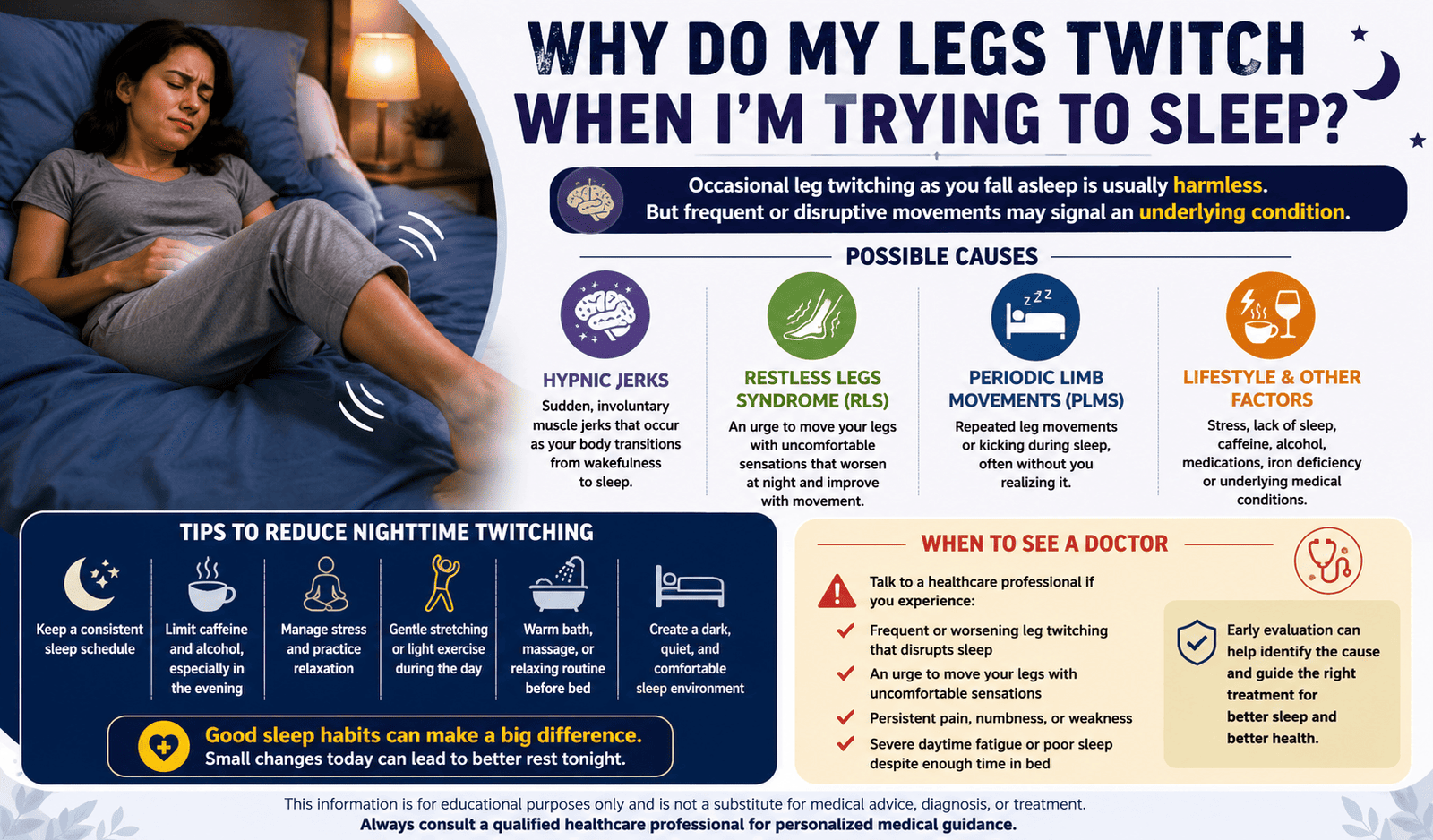
If you have ever been lying comfortably in bed and suddenly felt your leg jerk, kick, or twitch just as you were about to fall asleep, you may have wondered, “Why do my legs twitch when I’m trying to sleep?” In many cases, occasional leg twitching at bedtime is harmless and may happen because of normal changes that occur as your brain and muscles transition from wakefulness to sleep. These sudden movements are often called hypnic jerks or sleep myoclonus.
However, repeated nighttime leg movements can sometimes be associated with conditions such as restless legs syndrome (RLS) or periodic limb movements of sleep (PLMS). Stress, sleep deprivation, caffeine, alcohol, certain medications, and underlying health conditions may also contribute to nighttime muscle movements.
Why Do My Legs Twitch When I’m Trying to Sleep?
Your legs may twitch when you’re trying to sleep because your nervous system is transitioning from wakefulness to sleep. A sudden involuntary movement during this transition is known as a hypnic jerk and is usually harmless. If your legs repeatedly twitch or kick, especially along with an uncomfortable urge to move them, symptoms that worsen at night, or significant sleep disruption, restless legs syndrome or periodic limb movements of sleep may be involved.
Also Read : Is It Better to Sleep With Socks On?
What Causes Leg Twitching When You Are Falling Asleep?
One of the most common explanations is a hypnic jerk, also called a hypnagogic jerk or sleep myoclonus. This is a brief, involuntary muscle movement that can happen as you transition from wakefulness into light sleep. You might feel one leg suddenly kick, your whole body jerk, or experience a sensation that you are falling. Hypnic jerks can occur in otherwise healthy people and generally aren’t a sign of a serious problem.
The exact mechanism behind hypnic jerks is not completely understood. During the transition into sleep, the brain and muscles are changing their activity. One explanation is that the nervous system can briefly produce a muscle contraction during this transition. The result can be a quick jerk that wakes you for a moment before you settle back down.
Lifestyle factors can make these movements more noticeable. Stress, inadequate sleep, excessive caffeine, alcohol and certain stimulant substances may increase the likelihood of sleep-related jerks or make sleep less stable. Improving sleep habits and reducing potential triggers may help decrease how often these movements occur.
Also Read : Can Seasonal Changes Affect Your Sleep Cycle?
Could Restless Legs Syndrome Cause Nighttime Twitching?
Yes, but restless legs syndrome is somewhat different from a simple muscle twitch. RLS is a neurological sleep-related movement disorder characterized by an almost irresistible urge to move the legs, often accompanied by uncomfortable sensations such as crawling, pulling, aching, itching, throbbing or an electrical feeling.
RLS symptoms typically become worse when you are resting, sitting or lying down, and they are usually more noticeable in the evening or at night. Moving, stretching or walking often provides temporary relief. Some people with RLS also experience nighttime leg twitching because RLS can occur alongside periodic limb movements of sleep.
If your main experience is simply one sudden leg jerk as you fall asleep, that does not necessarily mean you have RLS. But if you repeatedly feel that you have to move your legs before you can sleep, RLS becomes a possibility worth discussing with a healthcare professional.
Also Read : Why Do I Wake Up at the Same Time Every Night?
What Is Periodic Limb Movement of Sleep?
Another possible explanation is periodic limb movements of sleep, commonly abbreviated as PLMS. Unlike RLS, which you generally notice while awake and resting, PLMS occurs during sleep. The legs may repeatedly jerk, kick or move at regular intervals, sometimes without the person realizing it.
Cleveland Clinic notes that these movements can occur repeatedly during sleep, sometimes approximately every 20 to 40 seconds. Some people only learn about them because a bed partner notices repeated kicking or because they wake feeling tired despite spending enough time in bed.
PLMS and RLS can occur together, but they are not the same condition. A person can have periodic limb movements during sleep without having the characteristic uncomfortable sensations and urge to move associated with RLS.
Also Read : How much sleep do adults over 40 need?
Can Stress Cause My Legs to Twitch at Night?
Stress may contribute to nighttime twitching, particularly when the twitching occurs as you are falling asleep. When you’re stressed, your nervous system may remain more alert than usual, making it harder for your body to smoothly transition into restful sleep.
Stress can also lead to poor sleep, muscle tension and increased caffeine consumption. Lack of sleep itself can make sleep-related muscle jerks more likely. Cleveland Clinic identifies stress and sleep deprivation among factors that can contribute to hypnic jerks and other sleep-disturbing movements.
Relaxing before bedtime, maintaining a consistent sleep schedule and addressing sources of ongoing stress may therefore help reduce occasional nighttime twitching.
Also Read : Why do I wake up sweating at night?
Can Caffeine Make Your Legs Twitch Before Sleep?
Caffeine can contribute to sleep problems and may make muscle twitching more noticeable in some people. Coffee, energy drinks, tea, soda and other caffeinated products can increase alertness and interfere with the normal transition into sleep, particularly when consumed later in the day.
If you notice that your legs twitch more often on days when you consume more caffeine, consider reducing your intake or avoiding caffeinated drinks later in the day. The goal isn’t necessarily to eliminate caffeine completely, but to determine whether your personal intake is affecting your sleep or nighttime movements.
Also Read : Can low vitamin D affect sleep?
Could Iron Deficiency Be Linked to Leg Twitching?
Iron deficiency can be associated with restless legs syndrome and may worsen symptoms in people who have RLS. Importantly, iron deficiency can occur even before someone develops obvious iron-deficiency anemia.
Mayo Clinic identifies iron deficiency as a possible contributor to RLS and notes that healthcare professionals may check iron levels when evaluating symptoms. Iron deficiency anemia itself can also be associated with restless legs syndrome.
You should not automatically start taking iron supplements simply because your legs twitch at night. Excess iron can be harmful, and treatment should be based on appropriate testing and professional guidance. Mayo Clinic specifically recommends having iron levels checked and being monitored by a healthcare professional before taking iron supplements for RLS.
Also Read : What causes sleep anxiety before workdays?
Can Medications Cause or Worsen Nighttime Leg Movements?
Some medications can contribute to or worsen sleep-related movement symptoms. Certain antidepressants, antihistamines, antipsychotic medications and other drugs have been associated with RLS or periodic limb movements in some people.
This does not mean you should stop a prescribed medication on your own. If your leg twitching began after starting a new medicine or changing a dose, tell your healthcare professional. They can determine whether the medication may be contributing and whether an alternative approach is appropriate.
Also Read : How to reset sleep schedule naturally?
Are Nighttime Leg Twitches a Sign of a Serious Problem?
Occasional twitching when you’re falling asleep is usually not a reason to panic. Hypnic jerks are common and can happen in otherwise healthy people.
The situation deserves more attention when movements are frequent, worsening, painful or consistently interfering with sleep. Repeated movements accompanied by an urge to move the legs, uncomfortable sensations, significant daytime sleepiness or persistent insomnia may warrant evaluation for RLS, PLMS or another sleep-related condition.
Nighttime movements can also occur in association with other medical problems. RLS, for example, can sometimes be associated with iron deficiency, peripheral neuropathy, kidney failure or certain neurological conditions.
Also Read : Why does my body feel heavy after waking up?
How Can I Reduce Leg Twitching Before Bed?
If your nighttime twitching is occasional and not caused by an underlying medical condition, improving your sleep routine may help. Try going to bed and waking up at consistent times, getting adequate sleep, limiting caffeine later in the day and creating a relaxing period before bedtime.
Gentle stretching or light movement may also be helpful, particularly if your legs feel tense after sitting for long periods. For people experiencing RLS symptoms, measures such as moderate regular exercise, massage, warm or cool packs, relaxation techniques and good sleep habits may provide relief.
Avoid relying on supplements as a first-line solution without knowing the cause. For example, iron supplementation is appropriate for iron deficiency in certain circumstances but should be guided by blood testing and a healthcare professional.
Also Read : Can sleep problems affect mental health?
When Should You See a Doctor About Leg Twitching?
Consider speaking with a healthcare professional if your leg twitching happens frequently, regularly prevents you from falling asleep, repeatedly wakes you during the night or causes significant daytime fatigue. You should also seek medical evaluation if the movements are accompanied by persistent pain, weakness, numbness, unusual sensations or other new neurological symptoms.
If you experience a strong urge to move your legs that becomes worse while resting and improves when you move, tell your healthcare professional because that pattern is characteristic of RLS. Diagnosis is generally based on your symptoms and medical history rather than a single test. Blood tests, particularly tests related to iron status, may help identify contributing factors.
A sleep study is not usually necessary to diagnose RLS, although a healthcare professional may recommend one when another sleep disorder is suspected.
Also Read : What are the best nighttime habits for deep sleep?
How Is Restless Legs Syndrome Treated?
Treatment depends on the cause and severity of symptoms. When RLS is related to an underlying problem such as iron deficiency, addressing that problem may improve symptoms. Lifestyle and sleep changes may also be recommended.
For persistent or more severe RLS, healthcare professionals may consider prescription treatments. The appropriate medication depends on the individual’s symptoms, health history and other medicines.
Because RLS treatment can be individualized and some medications may worsen symptoms in certain circumstances, it is better to receive personalized medical advice than to self-treat based solely on nighttime twitching.
Also Read : Why do I feel exhausted despite resting all day?
What Is the Difference Between a Hypnic Jerk, RLS and PLMS?
The easiest way to distinguish these conditions is to look at what happens and when it happens. A hypnic jerk is usually a brief, sudden muscle movement that occurs while you are falling asleep. It may happen occasionally and often does not indicate a disease.
Restless legs syndrome is characterized primarily by an uncomfortable sensation and a strong urge to move the legs. Symptoms become worse during rest and particularly in the evening or at night, while movement tends to provide temporary relief.
Periodic limb movements of sleep involve repetitive movements of the limbs while you are asleep. You may not be aware of them, although they can disturb sleep and contribute to daytime fatigue.
Understanding this distinction can help you describe your symptoms more accurately when talking with a healthcare professional.
Also Read : Can overthinking cause insomnia?
Frequently Asked Questions About Leg Twitching When Trying to Sleep
1. Why do my legs twitch when I’m trying to sleep but I’m not asleep yet?
A sudden leg jerk before you fall asleep may be a hypnic jerk. These involuntary movements can occur during the transition from wakefulness to sleep and are generally harmless, particularly when they happen occasionally.
2. Is it normal for your legs to twitch when falling asleep?
Occasional leg twitching while falling asleep can be normal. Hypnic jerks are a common form of sleep-related muscle movement. If the twitching becomes frequent, severe or disruptive to your sleep, however, it is reasonable to discuss it with a healthcare professional.
3. Why do my legs jerk at night when I lie down?
Leg jerking when you lie down can have several explanations. A brief jerk as you fall asleep may be a hypnic jerk, while repeated movements during sleep may be related to periodic limb movements. If lying down also causes an uncomfortable urge to move your legs, RLS may be worth considering.
4. Can restless legs syndrome cause twitching?
Yes. RLS is mainly characterized by an urge to move the legs and uncomfortable sensations that become worse during rest and at night. People with RLS may also experience nighttime leg twitching or kicking because RLS can occur alongside periodic limb movements of sleep.
5. Does magnesium deficiency cause my legs to twitch at night?
Leg twitching can have many causes, and magnesium deficiency is only one possible explanation for certain muscle symptoms. Nighttime twitching by itself does not prove that you have a magnesium deficiency. If symptoms are persistent or concerning, it is better to discuss appropriate evaluation with a healthcare professional rather than assuming a nutrient deficiency.
6. Can dehydration cause leg twitching before sleep?
Dehydration can contribute to muscle symptoms in some circumstances, particularly when fluid and electrolyte balance is affected, but occasional nighttime twitching is not automatically caused by dehydration. If twitching is persistent, recurrent or accompanied by other symptoms, consider discussing the pattern with a healthcare professional.
7. Does caffeine cause leg twitching at night?
Caffeine may contribute to nighttime twitching indirectly by increasing alertness and interfering with sleep. Cleveland Clinic lists caffeine among factors that can contribute to hypnic jerks and sleep disruption. Reducing late-day caffeine may help if you notice a clear connection.
8. Can stress cause muscle twitching when falling asleep?
Yes, stress may make sleep-related twitching more noticeable. Stress can interfere with sleep and keep the nervous system more alert during the period when the body is trying to transition into sleep. Managing stress and maintaining good sleep habits may reduce episodes for some people.
9. When should I worry about my legs twitching at night?
You should consider medical evaluation if twitching is frequent, worsening, painful, repeatedly interrupts your sleep or causes significant daytime fatigue. Evaluation is particularly important when twitching occurs with an irresistible urge to move the legs, persistent discomfort, weakness, numbness or other unusual neurological symptoms.
10. How can I stop my legs from twitching when I am trying to sleep?
Start by improving sleep consistency, getting enough sleep, limiting caffeine later in the day and using relaxing bedtime habits. Gentle stretching, massage and other relaxation techniques may also help some people. If the problem continues, a healthcare professional can determine whether RLS, PLMS, iron deficiency, medication effects or another condition may be contributing.

A healthy circadian rhythm supports better sleep.
Final Takeaway
So, why do my legs twitch when I’m trying to sleep? In many cases, the answer is a normal sleep-transition phenomenon called a hypnic jerk. Occasional jerking as you drift off is usually harmless. Stress, insufficient sleep and caffeine may make these movements more noticeable.
However, frequent nighttime movements deserve a closer look, especially when they come with an uncomfortable urge to move your legs, symptoms that worsen while resting, repeated kicking during sleep or persistent daytime tiredness. These patterns can point toward restless legs syndrome or periodic limb movements of sleep.
If your symptoms are persistent or affecting your quality of life, don’t assume the cause is simply a vitamin or mineral deficiency. A healthcare professional can review your symptoms, medications and health history and, when appropriate, check iron levels or investigate other possible causes.
This article is for educational purposes only and is not a substitute for individualized medical diagnosis or treatment. If you have persistent, severe or concerning symptoms, consult a qualified healthcare professional.
Medical Disclaimer: This article is for educational purposes only and does not replace professional medical advice, diagnosis, or treatment. Always consult a qualified healthcare provider before making significant changes to your diet, exercise routine, medications, or health management plan.
Medically reviewed information sourced from trusted health organizations.
References
- National Institutes of Health (NIH). Sleep and Sleep Disorders.
https://www.nhlbi.nih.gov/health/sleep - Sleep Foundation. Sleep Health Resources.
https://www.sleepfoundation.org/ - Centers for Disease Control and Prevention (CDC). Sleep and Sleep Disorders.
https://www.cdc.gov/sleep/ - Mayo Clinic. Sleep Disorders Overview.
https://www.mayoclinic.org/
Reviewed by: Dzarro Editorial Team
Fact-checked using trusted medical and scientific sources.

Sandip Choudhary is a Health & Wellness Researcher and Content Creator specializing in sleep, digestive health, preventive wellness, and evidence-based health education. He has been creating online content and researching health-related topics for several years, focusing on translating complex medical information into practical guidance for everyday readers.
With a strong background in SEO and content strategy, Sandip ensures that every article is optimized for both search engines and real users. His goal is to provide reliable, clear, and helpful information that supports healthier living.
Disclaimer: The content published is for informational purposes only and is not a substitute for professional medical advice.
2 thoughts on “Why Do My Legs Twitch When I’m Trying to Sleep?”
Comments are closed.