
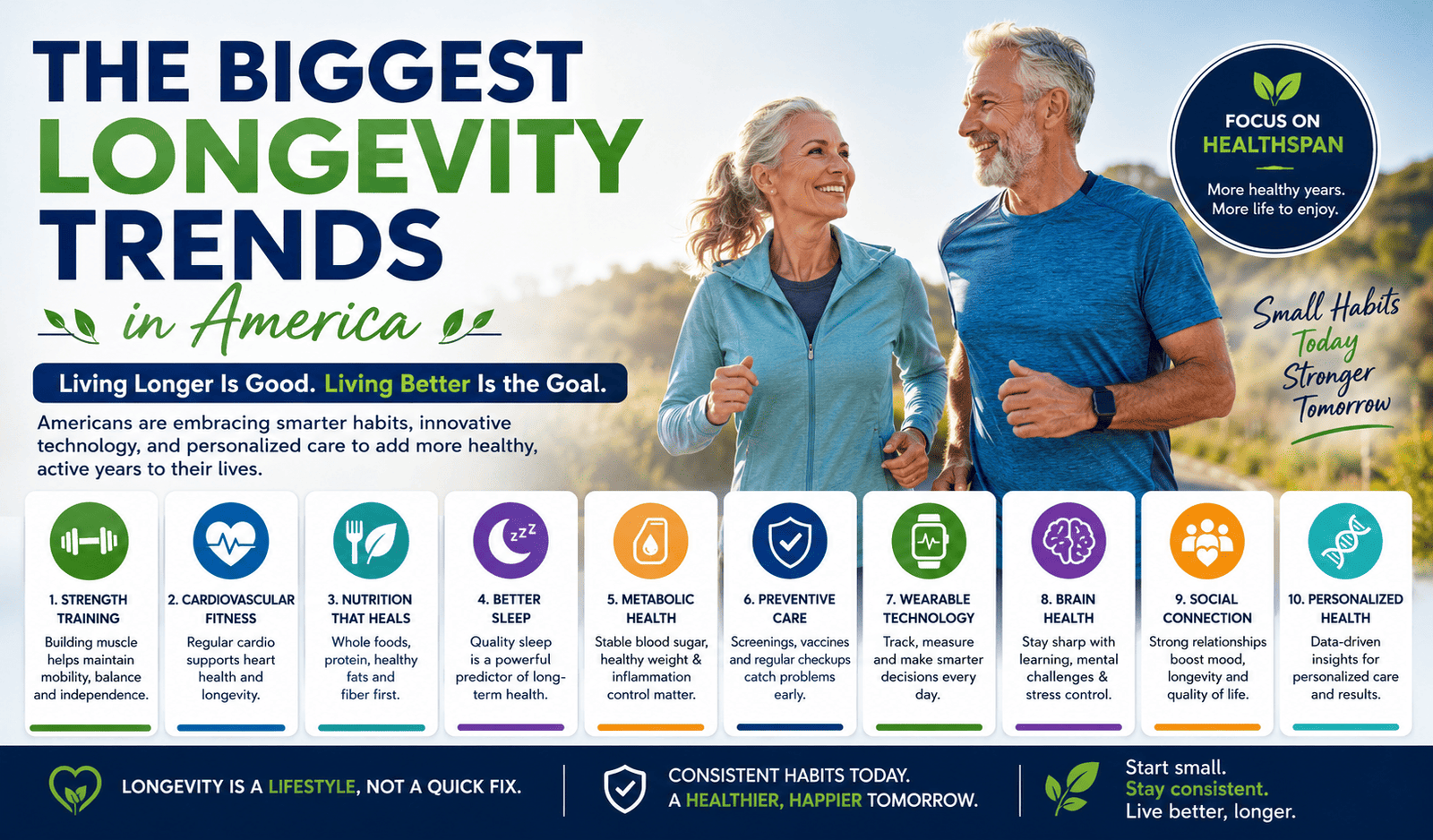
The biggest longevity trends in America are shifting from simply trying to live longer toward improving healthspan, or the number of years a person can live in good health and remain independent. Americans are increasingly focusing on strength training, cardiovascular fitness, healthy nutrition, sleep quality, metabolic health, preventive healthcare, wearable health technology, personalized medicine, brain health, and social connection. At the same time, medications such as GLP-1 drugs are becoming an important part of conversations about obesity and metabolic disease. However, no supplement, wearable, diet, or medication has been proven to guarantee a longer life. The strongest longevity strategy remains a combination of evidence-based lifestyle habits, preventive medical care, and individualized guidance from qualified healthcare professionals.
Introduction
Longevity has become one of the most discussed topics in American health and wellness. Instead of viewing aging as something that can only be addressed after health problems appear, more people are interested in maintaining physical function, cognitive health, metabolic health, and independence throughout adulthood. This change has helped transform longevity from a niche interest into a broader wellness movement.
The modern longevity conversation is also becoming more sophisticated. Earlier discussions often focused primarily on lifespan, but today’s approach increasingly emphasizes healthspan. The goal is not simply to add more years to life but to preserve the ability to move, think clearly, maintain meaningful relationships, and manage everyday activities as people grow older.
Scientific evidence continues to support many traditional health behaviors as important components of healthy aging. At the same time, emerging technologies are giving Americans new ways to monitor activity, sleep, heart rate, and other health-related measurements. Research published in 2026 found that wearable health-device use among U.S. adults increased from 30.2% in 2020 to 41.1% in 2024.
Also Read : What Does Aging Gracefully Really Mean?
1. The Shift From Lifespan to Healthspan
One of the biggest longevity trends in America is the growing emphasis on healthspan. Lifespan refers to how long someone lives, while healthspan describes the period of life spent in relatively good health and functional ability.
This distinction matters because living longer does not automatically mean living healthier. Americans interested in longevity are increasingly asking how they can preserve muscle, mobility, cardiovascular fitness, cognitive function, and independence as they age.
This trend is encouraging people to think about healthy aging decades before traditional retirement age. Rather than waiting for chronic disease or physical limitations to develop, preventive behaviors are increasingly being viewed as long-term investments.
Also Read : Healthy Aging Myths You Should Stop Believing
2. Strength Training Is Becoming a Longevity Priority
Strength training is moving beyond the traditional bodybuilding and fitness communities and becoming a major part of healthy-aging discussions. Maintaining muscle strength is particularly important as people age because physical function is closely connected to independence, mobility, and the ability to perform everyday activities.
The emphasis is not necessarily on building extremely large muscles. Instead, longevity-focused exercise programs often prioritize maintaining functional strength, balance, mobility, and resistance to age-related muscle loss.
Physical activity more broadly remains one of the most established components of healthy aging. The CDC states that regular physical activity can reduce the risk of several chronic diseases and premature death and is vital for healthy aging.
Despite growing awareness, there is still substantial room for improvement. CDC data show that only 47.2% of U.S. adults met federal aerobic physical-activity guidelines in 2024.
Also Read : Can You Slow Down Biological Aging?
3. Personalized Health Tracking With Wearables
Smartwatches, fitness trackers, rings, and other wearable devices are becoming increasingly important in America’s longevity movement. These devices can provide information about physical activity, heart rate, sleep, and other measurements, allowing users to observe patterns over time.
The growth is significant. A 2026 study of nationally representative U.S. survey data found that wearable use increased to 41.1% of adults in 2024, up from 30.2% in 2020.
However, more data does not automatically mean better health. Wearable measurements can be imperfect, and some readings may be difficult to interpret without clinical context. Researchers have also highlighted concerns involving privacy, data quality, interpretation, overdiagnosis, and the integration of wearable information into healthcare.
For that reason, wearable technology is best viewed as a tool for understanding patterns rather than a substitute for medical evaluation.
Also Read : Why Americans Are Focusing on Healthspan Instead of Lifespan?
4. Metabolic Health Is at the Center of Longevity
Metabolic health has become another major focus of the American longevity movement. Blood glucose regulation, blood pressure, cholesterol, body composition, and healthy weight are increasingly discussed together rather than as isolated issues.
This trend has been accelerated by growing public awareness of obesity, type 2 diabetes, cardiovascular disease, and other chronic conditions. Better metabolic health can support overall health, but the right approach varies considerably between individuals.
GLP-1 medications have also changed the conversation around metabolic health. According to CDC data, 26.5% of U.S. adults with diagnosed diabetes used GLP-1 injectables in 2024, representing an estimated 6.9 million adults.
These medications can be appropriate for certain medical conditions, but they should not be treated as general-purpose longevity drugs. Their benefits, risks, side effects, eligibility, and long-term use should be discussed with a qualified healthcare professional.
Also Read : The Science Behind Longevity Explained.
5. Nutrition Is Moving Toward Long-Term Health
Another important longevity trend is the movement away from short-term dieting toward sustainable nutrition. Instead of focusing exclusively on weight loss, many Americans are becoming more interested in dietary patterns that support cardiovascular health, metabolic health, muscle maintenance, and overall nutritional adequacy.
A longevity-oriented eating pattern generally emphasizes nutrient-dense foods such as vegetables, fruits, legumes, whole grains, nuts, seeds, and other minimally processed foods while keeping excessive amounts of added sugars, highly processed foods, and unhealthy fats in check.
Protein has also become an increasingly prominent topic because maintaining muscle becomes particularly important with aging. However, individual protein requirements can vary based on age, activity level, body size, kidney function, medical conditions, and other factors.
The broader trend is toward eating for long-term function rather than pursuing extreme diets that are difficult to maintain.
Also Read : Daily Habits That Support Healthy Aging
6. Sleep Is Becoming a Longevity Metric
Sleep is no longer viewed simply as time spent unconscious. It is increasingly recognized as an important component of overall health and recovery.
Americans interested in longevity are paying greater attention to sleep duration, regularity, sleep quality, nighttime interruptions, and daytime energy. Wearable technology has contributed to this trend by making sleep-related measurements more accessible.
However, consumer sleep scores should not be treated as medical diagnoses. If someone consistently experiences insomnia, loud snoring, gasping during sleep, excessive daytime sleepiness, or other concerning symptoms, professional evaluation may be more appropriate than relying solely on a device.
The larger longevity trend is straightforward: sleep is increasingly being treated as a foundational health behavior rather than an optional wellness activity.
Also Read : How to Live Longer Naturally?
7. Preventive Healthcare Is Becoming More Important
Longevity increasingly involves preventing problems rather than reacting to them after they become severe. Regular healthcare visits, age-appropriate screenings, vaccinations, blood-pressure monitoring, and management of chronic conditions can all play important roles in maintaining health.
This approach also recognizes that longevity is not determined by one behavior. Someone may exercise regularly but still have uncontrolled high blood pressure or an untreated medical condition. Preventive care provides an opportunity to identify risks that lifestyle tracking alone cannot detect.
The most useful longevity plan therefore combines healthy habits with appropriate medical care rather than treating wellness technology as a replacement for healthcare professionals.
Also Read : Healthspan vs Lifespan: What’s the Difference?
8. Brain Health and Cognitive Longevity
As Americans live longer, maintaining cognitive function has become a major part of the longevity conversation. Brain health increasingly encompasses physical activity, cardiovascular health, sleep, social engagement, nutrition, mental stimulation, and management of medical risk factors.
The growing interest in cognitive longevity reflects a broader change in how people think about aging. People are not only interested in how long their bodies remain functional; they also want to preserve memory, decision-making ability, independence, and quality of life.
There is no single intervention guaranteed to prevent cognitive decline. A more realistic approach is to address modifiable health risks while maintaining an active physical, mental, and social lifestyle.
Also Read : How to improve immune system naturally?
9. Social Connection Is Being Recognized as a Health Factor
Longevity is also becoming less focused on individual optimization. Social connection and meaningful relationships are receiving more attention as components of healthy aging.
The modern longevity movement increasingly recognizes that health is influenced by social environments as well as diet and exercise. Community participation, friendships, family relationships, purposeful activities, and opportunities to interact with others may all contribute to quality of life.
Recent U.S. research and policy discussions have increasingly examined social isolation alongside aging and healthcare challenges, reinforcing the idea that healthy aging cannot be separated entirely from social wellbeing.
Also Read : What causes chronic inflammation?
10. Personalized and Data-Driven Longevity
Another major trend is the move toward personalized health strategies. Instead of assuming that the same diet, exercise program, or health target works equally well for everyone, people are increasingly interested in using personal health information to make decisions.
Wearable data, laboratory testing, family history, medical history, lifestyle information, and clinical assessments can potentially contribute to a more individualized picture of health.
However, personalization should not become an excuse for abandoning basic evidence-based recommendations. A sophisticated longevity strategy still needs a foundation of physical activity, nutritious food, sufficient sleep, preventive care, and healthy social relationships.
Also Read : Why do I feel older than my age?
What These Longevity Trends Mean for Americans?
The biggest longevity trends in America point toward a more comprehensive definition of healthy aging. Longevity is increasingly about maintaining physical capacity, metabolic health, cognitive function, emotional wellbeing, and independence rather than simply chasing a higher number of years.
Technology will likely continue to influence this field. Wearables are already becoming more common, and researchers are exploring how continuously collected health information might contribute to disease prevention and healthcare. Yet current evidence also shows that wearable adoption does not automatically translate into consistent daily use or routine sharing of data with clinicians.
The most important lesson is that longevity does not require following every new wellness trend. Many of the fundamentals remain remarkably consistent. Regular physical activity, adequate sleep, nutritious eating, avoiding tobacco, maintaining healthy relationships, managing chronic disease, and receiving appropriate preventive care remain more important than chasing an expensive supplement or an unproven anti-aging treatment.
Also Read : What supplements support healthy aging?
The Future of Longevity in America
The future of longevity will likely combine conventional preventive medicine with increasingly sophisticated technology. Artificial intelligence, wearable sensors, personalized health platforms, metabolic treatments, and more detailed health monitoring may provide new opportunities for earlier intervention.
At the same time, healthcare professionals will remain essential because health data require interpretation. A device can measure a metric, but understanding whether that measurement matters requires context.
The biggest opportunity may therefore be to combine technology with proven health behaviors rather than replacing one with the other. Americans who use technology to support consistent exercise, sleep, nutrition, preventive care, and medical decision-making may gain more value than those who simply collect large amounts of health data.
Also Read : How to improve energy after 40?
Conclusion
The biggest longevity trends in America reflect a fundamental shift in how people think about aging. The goal is increasingly not just to live longer but to remain healthier, stronger, mentally capable, and independent for as many years as possible.
Strength training, cardiovascular activity, nutritious eating, metabolic health, sleep, preventive healthcare, wearable technology, brain health, social connection, and personalized care are all becoming important parts of the conversation. Some emerging technologies and treatments are promising, but they should be evaluated carefully rather than accepted simply because they are marketed as anti-aging solutions.
For most Americans, longevity is likely to be built through consistent habits and appropriate healthcare rather than one revolutionary intervention. The most practical strategy is to focus on evidence-based behaviors today while discussing individualized health goals and medical decisions with qualified healthcare professionals.
Also Read : Can inflammation speed up aging?
Frequently Asked Questions
1. What are the biggest longevity trends in America?
The biggest longevity trends include strength training, cardiovascular exercise, metabolic health, healthy nutrition, better sleep, preventive healthcare, wearable health tracking, brain health, social connection, and personalized medicine. The overall movement is shifting toward increasing healthspan rather than focusing only on lifespan.
2. What is the difference between lifespan and healthspan?
Lifespan is the total number of years a person lives. Healthspan refers to the years spent in relatively good health and with functional independence. Modern longevity research and wellness discussions increasingly emphasize extending healthspan rather than simply increasing lifespan.
3. Can exercise help people live longer?
Regular physical activity is strongly associated with better health outcomes and can reduce the risk of several chronic diseases and premature death. The CDC identifies physical activity as an important component of healthy aging.
4. Is strength training important for longevity?
Strength training can help maintain muscle strength and physical function, which are especially important as people age. A well-designed program can complement aerobic exercise and other activities that support healthy aging.
5. Are wearable devices useful for longevity?
Wearable devices can help people track measurements such as physical activity, heart rate, and sleep-related patterns. Their use among U.S. adults has increased substantially, but wearable data should be interpreted carefully and should not replace professional medical evaluation when health concerns exist.
6. Are GLP-1 medications longevity drugs?
GLP-1 medications are primarily used for specific medical conditions such as diabetes and, depending on the medication and indication, obesity. They should not automatically be considered longevity drugs. Whether a GLP-1 medication is appropriate depends on an individual’s medical circumstances and should be determined with a healthcare professional.
7. What diet is best for longevity?
There is no single diet proven to guarantee longevity for everyone. A sustainable eating pattern emphasizing nutrient-dense, minimally processed foods and adequate nutrition is generally more consistent with long-term health than extreme or highly restrictive diets.
8. Does sleep affect healthy aging?
Sleep is an important component of overall health and recovery. Consistently poor sleep can be associated with a range of health problems. People with persistent sleep problems or symptoms suggesting a sleep disorder should discuss them with a healthcare professional.
9. Can social relationships affect longevity?
Social connection is increasingly recognized as an important component of healthy aging and quality of life. Maintaining meaningful relationships and participating in social or community activities can be valuable parts of a broader healthy-aging strategy.
10. What is the best way to start a longevity plan?
Start with fundamentals rather than expensive anti-aging products. Focus on regular physical activity, strength and aerobic exercise appropriate for your ability, nutritious food, adequate sleep, avoiding tobacco, meaningful social connections, and recommended preventive healthcare. If you have medical conditions or take medications, discuss your longevity goals with your healthcare professional before making major changes.

Recovery is essential after exercise.
Medical Disclaimer: This article is for general educational and informational purposes and is not a substitute for professional medical advice, diagnosis, or treatment. Longevity strategies, medications, supplements, exercise programs, and dietary changes should be individualized based on a person’s health history and discussed with an appropriately qualified healthcare professional.
Medically reviewed information sourced from trusted health organizations.
References
- National Institute on Aging (NIA). Healthy Aging and Longevity Resources.
https://www.nia.nih.gov/health - National Institutes of Health (NIH). Healthy Aging Research.
https://www.nih.gov/health-information - Centers for Disease Control and Prevention (CDC). Healthy Aging.
https://www.cdc.gov/aging - Harvard T.H. Chan School of Public Health. Nutrition and Healthy Aging.
https://www.hsph.harvard.edu/nutritionsource
Reviewed by: Dzarro Editorial Team
Fact-checked using trusted medical and scientific sources.

Sandip Choudhary is a Health & Wellness Researcher and Content Creator specializing in sleep, digestive health, preventive wellness, and evidence-based health education. He has been creating online content and researching health-related topics for several years, focusing on translating complex medical information into practical guidance for everyday readers.
With a strong background in SEO and content strategy, Sandip ensures that every article is optimized for both search engines and real users. His goal is to provide reliable, clear, and helpful information that supports healthier living.
Disclaimer: The content published is for informational purposes only and is not a substitute for professional medical advice.
3 thoughts on “The Biggest Longevity Trends in America”
Comments are closed.