
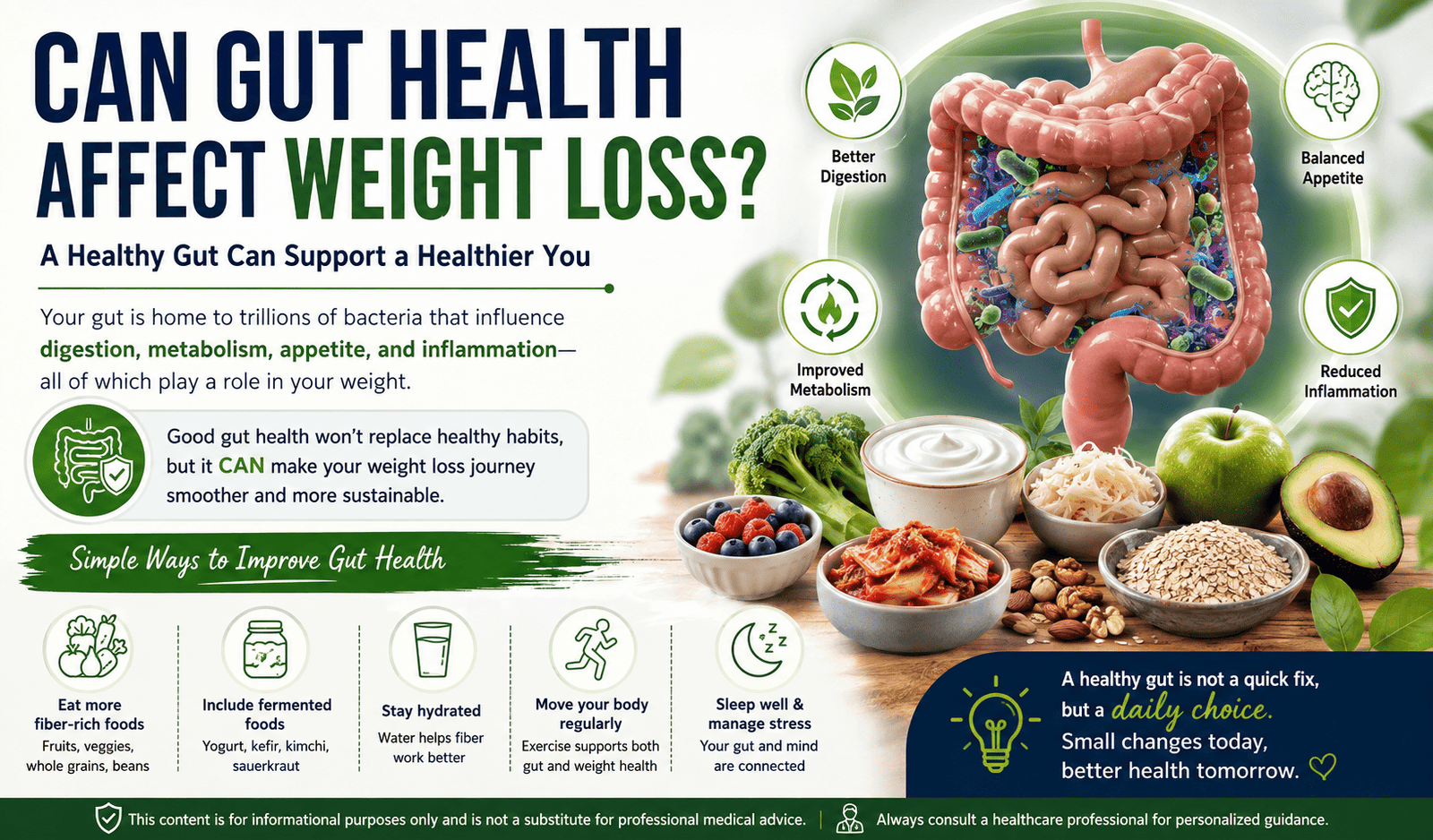
Yes, gut health can affect weight loss, but it is only one part of the picture. The trillions of microorganisms living in your digestive tract, collectively known as the gut microbiome, can influence digestion, appetite, energy metabolism, inflammation, and how your body responds to food. Research suggests that differences in gut microbiome composition may be associated with obesity and differences in weight-loss responses. However, having a certain type of gut bacteria does not automatically cause weight gain or prevent weight loss. Sustainable weight management still depends on overall diet quality, calorie intake, physical activity, sleep, medications, genetics, and other health factors.
What Is Gut Health?
Gut health refers to how well your digestive system functions and how balanced and diverse the microorganisms living throughout your gastrointestinal tract are. Your gut contains bacteria and other microorganisms that interact with the food you eat and with your body. These microbes participate in processes related to digestion, nutrient metabolism, immune function, and the production of compounds that can influence health.
The gut microbiome is highly individual. Diet, environment, medications, and other factors can influence which microorganisms are present and how they behave. A diet rich in fiber can particularly influence the composition and activity of intestinal microbes because certain gut bacteria ferment dietary fiber and produce short-chain fatty acids, compounds that have important effects throughout the body.
Also Read : Do prebiotics really improve digestion?
Can Gut Health Affect Weight Loss?
Yes, gut health may influence weight loss through several biological pathways. Researchers are increasingly studying the relationship between gut microorganisms and energy balance, which includes both how much energy enters the body through food and how that energy is used or stored.
Some gut microorganisms can help break down components of food that humans cannot digest on their own. During this process, microbes produce metabolites that may influence metabolism and other physiological functions. Research reviews suggest that the gut microbiome can affect energy balance through multiple mechanisms involving digestion, metabolism, appetite-related signaling, and inflammation.
However, it is important not to oversimplify this relationship. Gut health is not a magic switch that determines whether you lose weight. A person can have a relatively healthy gut and still gain weight if their overall energy intake consistently exceeds their body’s needs. Likewise, improving gut health does not guarantee weight loss.
The National Institute of Diabetes and Digestive and Kidney Diseases explains that sustainable weight management generally involves a healthy eating pattern and regular physical activity. Reducing overall calorie intake while choosing nutrient-dense foods can support weight loss, while physical activity can help with weight management and maintaining weight loss.
Also Read : What are the best probiotics for gut health?
How Does the Gut Microbiome Influence Weight?
One possible connection involves how gut bacteria process food. The microorganisms in your digestive tract can influence how nutrients are broken down and how energy is extracted from certain foods. Harvard Health notes that researchers are investigating whether differences in gut bacteria may affect the amount of energy people extract from food.
Another potential mechanism involves appetite and metabolic signaling. Gut microorganisms can produce metabolites that interact with the body and may influence hormones, inflammation, and other pathways involved in appetite and energy regulation. Scientists are still working to understand exactly how these mechanisms translate into differences in body weight between individuals.
Inflammation may also be part of the connection. Research has linked obesity and metabolic health with changes in the gut microbiome, although the relationship is complex and appears to work in both directions. Diet can influence the microbiome, while the microbiome can influence metabolic processes. This means that gut health and body weight may affect one another rather than existing as completely separate issues.
Also Read : How long does it take to restore gut health?
Does a Healthy Gut Help You Lose Weight?
A healthy gut may support behaviors and physiological processes that make healthy weight management easier, but it should not be considered a standalone weight-loss treatment. One important reason is that many foods associated with better gut health are also foods that can make a balanced diet more satisfying and nutrient-dense.
Fruits, vegetables, beans, lentils, whole grains, nuts, and seeds provide dietary fiber and other nutrients. Fiber can help add bulk to meals, support regular bowel movements, and contribute to feelings of fullness. NIDDK recommends fiber-rich foods such as whole grains, legumes, fruits, vegetables, and nuts as part of a healthy eating pattern.
This creates an important practical connection: eating a variety of minimally processed, fiber-rich foods can support both digestive health and a sustainable approach to weight management.
Also Read : Is bloating a sign of poor gut health?
Can Poor Gut Health Make It Harder to Lose Weight?
Possibly, but the evidence does not support saying that poor gut health is always the reason someone cannot lose weight. Weight regulation is influenced by numerous factors, including food intake, physical activity, genetics, sleep, medications, stress, hormones, medical conditions, and long-term eating patterns.
Studies have identified associations between gut microbiome characteristics and obesity, and research has also found that weight-loss interventions can change the gut microbiome. However, those changes do not always correspond directly with the amount of weight lost. A systematic review of weight-loss interventions found that different approaches produced changes in gut microbiota, but the relationship between microbiome changes and weight loss was not always consistent.
Therefore, blaming difficulty losing weight entirely on the gut microbiome can be misleading. If someone has persistent unexplained weight gain, significant digestive symptoms, or difficulty losing weight despite consistent lifestyle changes, discussing the situation with a healthcare professional may be more useful than purchasing an unproven “gut cleanse” or supplement.
Also Read : Can poor gut health cause anxiety and depression?
What Foods Support Gut Health and Weight Management?
A gut-friendly eating pattern generally emphasizes a wide variety of plant foods, adequate fiber, nutritious protein sources, and minimally processed foods. Whole fruits and vegetables, beans, lentils, oats, whole grains, nuts, and seeds can provide different types of dietary fiber that gut microorganisms can use.
Fermented foods such as yogurt with live cultures, kefir, sauerkraut, kimchi, and other traditionally fermented foods may also be included in a balanced diet when they are appropriate for the individual. However, not every fermented product has the same microbial content, and fermented foods should not be viewed as a guaranteed weight-loss solution.
Variety matters because different types of fiber can support different groups of gut microorganisms. Harvard’s Nutrition Source notes that dietary fiber influences the gut microbiota and that fermentation of certain fibers produces short-chain fatty acids.
If your current diet is low in fiber, increasing it gradually may be more comfortable than making a sudden dramatic change. NIDDK recommends increasing fiber gradually and drinking enough fluids because adequate fluid intake helps fiber work effectively.
Also Read : What foods heal the gut lining?
How Much Fiber Should You Eat for Gut Health?
For most adults, NIDDK states that the general recommended range is about 22 to 34 grams of fiber per day, depending on age and sex. Individual needs can vary, and some people with digestive conditions may need personalized dietary advice.
Rather than focusing only on reaching a specific number, it can be helpful to gradually include fiber-rich foods throughout the day. For example, someone might choose oatmeal and berries at breakfast, beans or lentils with vegetables at lunch, and whole grains and vegetables with dinner.
If increasing fiber causes significant bloating, abdominal pain, diarrhea, constipation, or other persistent symptoms, it is worth discussing those symptoms with a healthcare professional rather than assuming they are simply part of “detoxing.”
Also Read : What are the signs of an unhealthy gut?
Do Probiotics Help With Weight Loss?
Probiotics are live microorganisms that may provide health benefits when consumed in adequate amounts, but their effects can vary significantly by strain, dose, and individual characteristics. Some research has found associations between probiotic or prebiotic interventions and modest changes in body weight, BMI, or fat mass, but the evidence is not strong enough to treat probiotics as a universal weight-loss solution.
A systematic review of gut microbiome interventions found that probiotics and prebiotics showed potential effects on body weight and body fat, but researchers also emphasized the need for further research regarding the appropriate formulations, doses, duration, and long-term effects.
For that reason, buying an expensive probiotic specifically for weight loss may not be the best first step. Improving the overall quality and variety of your diet is generally a more fundamental approach.
Also Read : Can gut health affect energy levels?
Can Gut Health Affect Belly Fat?
Gut health may be associated with metabolic health and body-fat distribution, but there is currently no reliable evidence that simply changing gut bacteria will specifically burn belly fat. Abdominal fat is influenced by overall energy balance, genetics, age, hormones, physical activity, diet, sleep, and other factors.
If reducing abdominal fat is your goal, focusing on sustainable weight-management behaviors is more appropriate than relying on products marketed as “gut fat burners.” Regular physical activity, a nutritious eating pattern, adequate sleep, and appropriate calorie intake remain important components of healthy weight management.
NIDDK recommends regular physical activity as part of weight management, with the Physical Activity Guidelines for Americans recommending at least 150 minutes of moderate-intensity aerobic activity per week for healthy adults, along with muscle-strengthening activities on at least two days per week.
Also Read : Can gut health affect mental health?
How to Improve Gut Health While Trying to Lose Weight?
Improving gut health does not require an extreme cleanse, restrictive diet, or collection of supplements. A sustainable approach is to gradually increase the variety of plant foods in your diet while maintaining adequate protein and choosing mostly minimally processed foods.
Eating different fruits and vegetables throughout the week can provide different types of fiber and plant compounds. Beans, lentils, whole grains, nuts, and seeds can further increase dietary fiber. Drinking adequate fluids can help when increasing fiber intake.
It is also important to avoid making your diet unnecessarily restrictive. Extremely restrictive diets may reduce dietary variety and make it harder to meet nutritional needs. Sustainable weight loss is generally more useful than pursuing rapid changes that are difficult to maintain.
Physical activity is another important piece of the equation. Walking, resistance training, cycling, swimming, and other forms of movement can support overall health and weight management. NIDDK emphasizes that healthy eating and physical activity work together to help people lose weight and maintain it over time.
Also Read : How long does gut healing take?
Gut Health and Weight Loss: What the Science Really Says
The relationship between gut health and weight is real but complicated. Research suggests that the gut microbiome participates in energy metabolism and may influence appetite, inflammation, nutrient processing, and other processes related to body weight. At the same time, diet and weight-loss interventions can alter the gut microbiome.
What researchers do not yet know is whether there is one specific “ideal” microbiome that causes everyone to lose weight more easily. Gut microorganisms vary considerably between individuals, and research has not established a simple formula in which changing a particular bacterial species automatically produces predictable weight loss.
This is why gut health should be viewed as one component of a broader healthy lifestyle rather than a replacement for evidence-based weight-management strategies.
Also Read : Does fasting improve gut health?
When Should You Talk to a Doctor?
Persistent digestive symptoms should not automatically be attributed to an unhealthy gut microbiome. Symptoms such as ongoing abdominal pain, persistent diarrhea or constipation, blood in the stool, unexplained weight loss, repeated vomiting, difficulty swallowing, or significant changes in bowel habits warrant medical evaluation.
You should also consider speaking with a healthcare professional if you have been consistently following healthy eating and physical activity habits but are experiencing unexplained weight gain or difficulty managing your weight. Certain medications and medical conditions can affect body weight, and identifying those factors may require professional evaluation.
If you are considering a probiotic, restrictive diet, supplement, or major dietary change, a registered dietitian or other qualified healthcare professional can help determine whether it is appropriate for your individual situation.
Also Read : Best morning routine for gut health?
Frequently Asked Questions
1. Can gut health affect weight loss?
Yes. Gut health and the gut microbiome may influence digestion, energy metabolism, appetite-related signaling, and inflammation, all of which can be connected to weight regulation. However, gut health is only one factor affecting weight loss, and improving your gut microbiome does not guarantee weight loss.
2. Can an unhealthy gut cause weight gain?
An altered gut microbiome has been associated with obesity and metabolic changes, but it would be inaccurate to say that an unhealthy gut directly causes weight gain in every person. Body weight is influenced by many interacting factors, including diet, activity, genetics, medications, sleep, hormones, and medical conditions.
3. What is the best food for gut health and weight loss?
There is no single best food. A varied diet containing vegetables, fruits, beans, lentils, whole grains, nuts, and seeds can provide different types of dietary fiber that support gut microorganisms while contributing to a nutrient-dense eating pattern.
4. Does fiber help with weight loss?
Fiber can support a healthy weight-management diet because fiber-rich foods can be filling and are often nutrient-dense. Fiber also supports normal bowel function and interacts with gut microorganisms. Adults generally need about 22 to 34 grams of fiber per day, although individual requirements vary.
5. Can probiotics help me lose weight?
Some studies have reported modest effects of certain probiotics or prebiotics on body weight, BMI, or fat mass, but results vary by product and individual. More research is needed before probiotics can be considered a reliable standalone weight-loss treatment.
6. Does gut bacteria affect metabolism?
Yes, gut microorganisms can influence metabolic processes through the compounds they produce and through interactions with digestion and the body’s physiological systems. Researchers are still determining how specific microbiome differences affect metabolism and weight in individual people.
7. Can improving gut health reduce belly fat?
Improving gut health may support overall metabolic health, but there is no proven gut-health method that specifically targets belly fat. Reducing excess body fat generally requires a sustainable approach involving nutrition, physical activity, and other lifestyle factors.
8. How long does it take to improve gut health?
There is no universal timeline. The gut microbiome can respond to dietary changes, but the effects vary from person to person. Consistently eating a diverse, fiber-rich diet is more useful than expecting an immediate transformation from a short-term cleanse or supplement.
9. Should I take a probiotic for gut health?
Not everyone needs a probiotic supplement. Different probiotic strains can have different effects, and supplements are not interchangeable. If you are considering one for digestive or weight-related concerns, discussing your specific situation with a healthcare professional can help you make an informed decision.
10. Can gut health alone help me lose weight?
No. Gut health may contribute to weight regulation, but it cannot replace the fundamentals of healthy weight management. A sustainable eating pattern, appropriate calorie intake, regular physical activity, adequate sleep, and attention to medical factors all remain important.

Chronic constipation can indicate an unhealthy digestive system.
Final Takeaway
So, can gut health affect weight loss? The evidence suggests that it can play a meaningful role, particularly through the gut microbiome’s relationship with digestion, energy metabolism, appetite signaling, and inflammation. However, the science does not support the idea that a “bad gut” is the sole reason someone struggles with weight.
The most practical approach is to support your gut as part of an overall healthy lifestyle. Eat a diverse range of fiber-rich foods, stay adequately hydrated, choose mostly nutrient-dense foods, stay physically active, and focus on habits you can maintain long term. If you have persistent digestive symptoms or unexplained changes in weight, speak with a qualified healthcare professional rather than relying on online gut-health claims or unproven supplements.
Medical Disclaimer: This article is for general educational purposes and does not provide individual medical advice, diagnosis, or treatment. If you have persistent digestive symptoms, a diagnosed gastrointestinal condition, or concerns about using a prebiotic supplement, speak with a qualified healthcare professional.
Medically reviewed information sourced from trusted health organizations.
Reviewed by: Dzarro Editorial Team
Fact-checked using trusted medical and scientific sources.

Sandip Choudhary is a Health & Wellness Researcher and Content Creator specializing in sleep, digestive health, preventive wellness, and evidence-based health education. He has been creating online content and researching health-related topics for several years, focusing on translating complex medical information into practical guidance for everyday readers.
With a strong background in SEO and content strategy, Sandip ensures that every article is optimized for both search engines and real users. His goal is to provide reliable, clear, and helpful information that supports healthier living.
Disclaimer: The content published is for informational purposes only and is not a substitute for professional medical advice.
1 thought on “Can gut health affect weight loss?”
Comments are closed.