
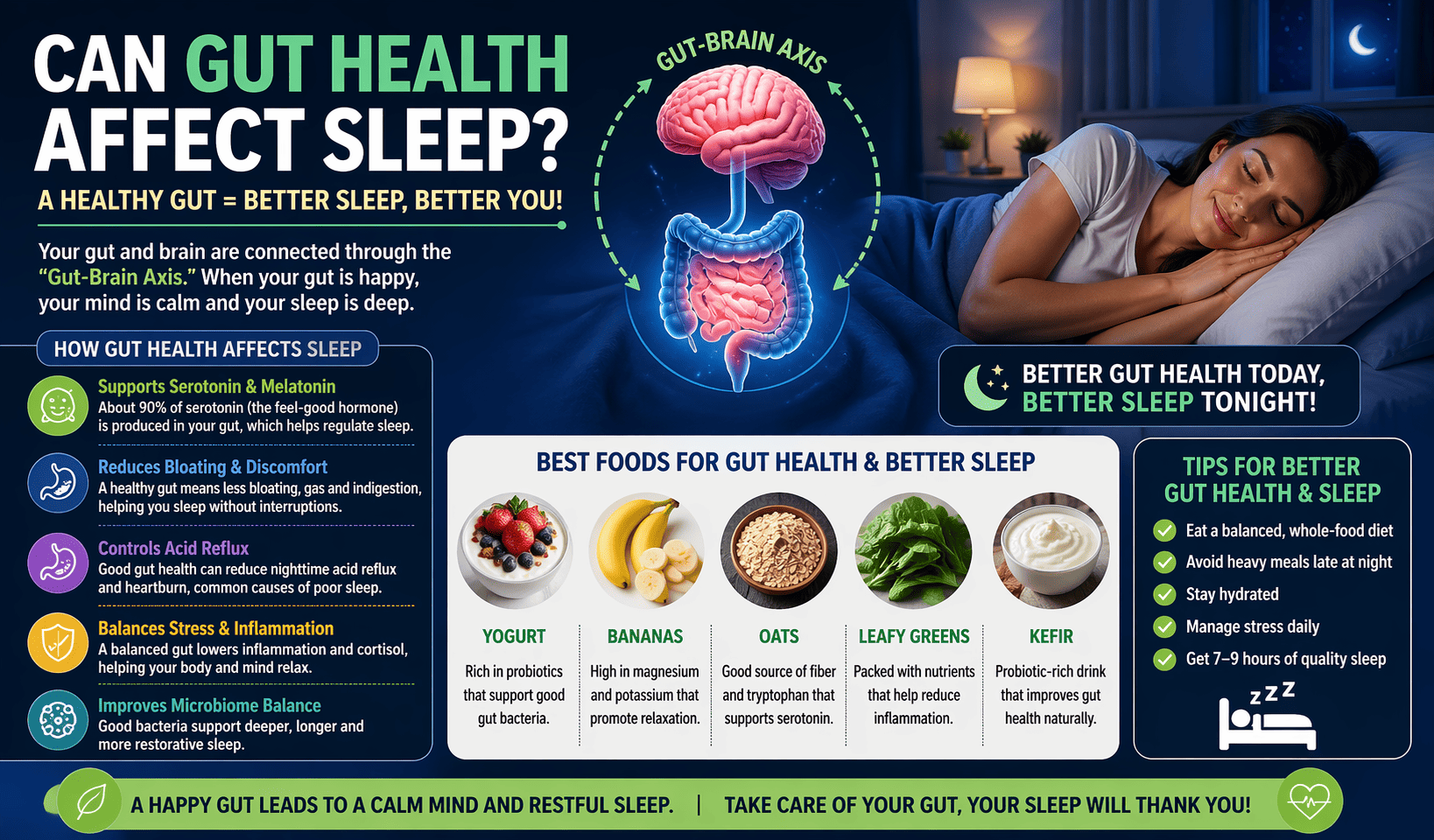
Yes — gut health can directly affect your sleep. If your digestion is off, your sleep quality often suffers too. This isn’t just a trend; it’s backed by growing research on the gut-brain axis, a communication network linking your digestive system and brain.
If you’ve ever had:
- Bloating at night
- Acid reflux when lying down
- Restless sleep after heavy meals
👉 Your gut may be the hidden cause.
What Is the Gut-Brain Connection?
Your gut and brain constantly “talk” through:
- The vagus nerve
- Hormones
- Neurotransmitters
👉 In fact, about 90% of serotonin (the “feel-good” hormone that helps regulate sleep) is produced in your gut.
So when your gut microbiome is imbalanced:
- Mood changes
- Stress increases
- Sleep cycles get disrupted
How Gut Health Affects Sleep
1. Serotonin & Melatonin Disruption
Your gut helps produce serotonin, which converts into melatonin (the sleep hormone).
👉 Poor gut health =
❌ Low serotonin
❌ Low melatonin
➡️ Difficulty falling asleep
2. Night-Time Bloating & Discomfort
If you experience:
- Gas
- Bloating
- Indigestion
👉 Your body stays in “alert mode,” making deep sleep difficult.
3. Acid Reflux (GERD) at Night
Many Americans suffer from nighttime reflux.
Symptoms:
- Burning chest
- Sour taste
- Waking up suddenly
👉 This can repeatedly interrupt your sleep cycle.
4. Gut Inflammation & Stress Hormones
An unhealthy gut can increase inflammation and cortisol (stress hormone).
👉 High cortisol at night =
❌ Light sleep
❌ Frequent wake-ups
5. Microbiome Imbalance (Dysbiosis)
When “good bacteria” decrease:
- Sleep quality drops
- REM sleep reduces
- Fatigue increases
👉 This deep sleep guide explains how to improve overnight recovery naturally.
Signs Your Gut Is Affecting Your Sleep
Watch for these combined symptoms:
- You feel tired even after 7–8 hours
- You wake up at 2–3 AM frequently
- You have bloating after dinner
- You feel anxious at night
- You experience acid reflux
👉 If yes, your gut health likely needs attention.
How to Improve Gut Health for Better Sleep
✔ Eat Sleep-Friendly Foods
Include:
- Yogurt (probiotics)
- Bananas (magnesium)
- Oats (fiber)
- Leafy greens
👉 These support both gut bacteria and sleep hormones.
✔ Avoid Heavy Meals at Night
- Stop eating 2–3 hours before bed
- Avoid spicy & oily foods
👉 This reduces reflux and improves sleep quality.
✔ Add Probiotics & Prebiotics
- Probiotics = good bacteria
- Prebiotics = food for bacteria
👉 Together, they balance your microbiome.
✔ Manage Stress
Stress damages gut bacteria.
Try:
- Deep breathing
- Light evening walks
- Meditation
✔ Fix Your Sleep Routine
- Sleep at the same time daily
- Avoid screens before bed
- Keep room dark & cool
How Long Does It Take to See Results?
If you improve gut health:
- 3–7 days → better digestion
- 2–3 weeks → improved sleep quality
- 1–2 months → stable sleep cycle
Final Thoughts
👉 Yes, gut health plays a major role in sleep quality.
If your sleep is poor, don’t just look at:
❌ Mattress
❌ Screen time
Also check:
✅ Digestion
✅ Diet
✅ Gut bacteria
FAQs
Q1. Can gut problems cause insomnia?
Yes. Gut imbalance can affect serotonin and melatonin, leading to sleep issues.
Q2. What is the best food for gut health and sleep?
Foods like yogurt, bananas, oats, and leafy greens support both digestion and sleep.
Q3. Can probiotics improve sleep?
Yes. Probiotics help balance gut bacteria, which can improve sleep quality.
Q4. Why do I wake up at 3 AM every night?
It may be due to stress, cortisol imbalance, or gut-related issues like inflammation.
Medically reviewed information sourced from trusted health organizations.
References
- National Institutes of Health (NIH). Sleep and Sleep Disorders.
https://www.nhlbi.nih.gov/health/sleep - Sleep Foundation. Sleep Health Resources.
https://www.sleepfoundation.org/ - Centers for Disease Control and Prevention (CDC). Sleep and Sleep Disorders.
https://www.cdc.gov/sleep/ - Mayo Clinic. Sleep Disorders Overview.
https://www.mayoclinic.org/
Reviewed by: Dzarro Editorial Team
Fact-checked using trusted medical and scientific sources.
Last Updated: June 13, 2026

Sandip Choudhary is a Health & Wellness Researcher and Content Creator specializing in sleep, digestive health, preventive wellness, and evidence-based health education. He has been creating online content and researching health-related topics for several years, focusing on translating complex medical information into practical guidance for everyday readers.
With a strong background in SEO and content strategy, Sandip ensures that every article is optimized for both search engines and real users. His goal is to provide reliable, clear, and helpful information that supports healthier living.
Disclaimer: The content published is for informational purposes only and is not a substitute for professional medical advice.